Monthly Archives: January 2021

The Good People of 2021: Recommending Good Books & Other Challenges

Darn, they would never leave the bar and join a book club!

Shortly after my first marriage, I got stuck at a party in the country. It was not the least bit Chekhovian, and I wished I’d stayed home. I was very bored, as the only sober person, and I couldn’t leave, as the only non-driver. I perched in the kitchen and read The Whole Earth Catalogue cover-to-cover while the other guests wandered around the edge of a corn field boisterous and drunk. Afterwards, I told my alcoholic first husband how boring I found his friends.

“They’re good people,” he told me.

That depends on your point-of-view. They drank every night at the same bar, so in a sense he knew them better than anyone. His people were his people… and by my standards, they were not particularly wonderful.

But seriously, what is good? Is it good to host a party where everyone gets wasted? I am not saying it is bad, but is it good? There is drinking in the Symposium, but did the guests pass out from too much wine? I don’t remember that part…

What I learned from the non-Chekhovian party: never go to a party in the country and bring your own book.

AND NOW LET ME DISCUSS SOME READING CHALLENGES OF 2021

Any person who can recommend a good book is a good person in my book. But sometimes there is too much goodness, if you know what i mean. I can get my head around the concept of Women in Translation in August or German literature in November, but Book Riot’s “Read Harder” challenges are so issue-oriented they seem satiric.

For example:

A Book Riot Read Harder Challenge: A Romance by a Trans and/or Nonbinary Author.
I wish I were kidding, but I’m not. So…this is actually a genre? I promise you I will never read romances by Trans and Nonbinary Authors. Likewise, I will never read romances by Heterosexual and Homosexual authors. The world ended the day Ron Charles, editor at The Washington Post Book World, wrote an article in which he pretended to like romance novels. Similarly, Michael Dirda occasionally mentions Georgette Heyer’s The Grand Sophy. The women remain silent…


Some Book Riot “Read Harder” challenges are decidedly noble. There is a challenge to read “books about disabled, chronically ill, Deaf, or neurodivergent authors.” (Why is “deaf” capitalized?_ And what kind of circumlocution is “neurodivergent”? Does it refer to Carrie Fisher, William Styron, Emily Dickinson, Hemingway, and Byron? I recommend the following:

I can get my head around the following challenge, but is it preaching to the choir?

THE “READING WOMEN” PODCAST HOSTS “THE READING WOMEN CHALLENGE.” But does anyone who participates in this challenge actually need it? I read mostly women authors, and my guess is other women do, too. But I admit, I have never read and will never read”a Muslim middle grade novel” or”short story collection by a Caribbean writer” (unless I see one at a bookstore).

The next book challenge is for the stodgy and makes sense, sort of, in a goofy way.

THE 52 BOOK CLUB READING CHALLENGE. Fifty-two books in 52 weeks. No problem! The prompts are a little silly, as these things tend to be, but I am quite sure I can handle reading a “book with a deckled edge” or “a book you’d rate 5 stars.”

If all else fails, you can choose the latest books at The Most Anticipated Books of 2021 Goodreads and then participate in the Goodreads Challenge, which involves typing the number of books you hope to read and then trying to meet the challenge.

Happy 2021, and May You Find the Challenge for You!

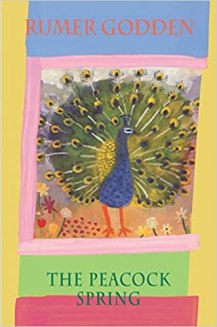
Out of Time: Rumer Godden’s “The Peacock Spring”

Rumer Godden

Rumer Godden is one of my favorite middlebrow writers, and I’ve been thinking about her because of the lavish TV adaptation of Black Narcissus (the first of her three nun novels, published in 1939). I prefer Godden’s later nun classic, In This House of Brede (1969), but I am fascinated by the disturbing portrayal in Black Narcissus of the dazed nuns distracted by the beautiful Himalayan landscape.

I went through a Godden-mad phase in the zips, when I searched online for her (mostly) out-of-print novels. I was so impressed by these books, and so surprised that so few people read her. Like many women of my generation, I discovered her when I was a child: she wrote several books about dolls, but my favorite was An Episode of Sparrows, about a garden in London. And, as I have indicated above, I was absolutely crazy about In This House of Brede, to the point that I considered becoming a nun–for about an hour.

Now Virago has reissued most of Godden’s books, but I do have several older copies. The other day I was browsing my shelves and found an old book club edition of The Peacock Spring (bought for $1), which I had never read. I am lukewarm about her later books: 1974 is past the date of vintage Godden! This one is not quite as great as some of her others, but Godden’s style is lyrical and witty, and she always has something worth saying.

Born in England and raised in India, Godden manages to be quotidian and unconventional at the same time. Set in India, The Peacock Spring is partly a love story, partly a hate story. Two English half-sisters, fifteen-year-old Una and her frivolous younger sister, Hal, are yanked out of boarding school before the end of term. Their father, Edward, a diplomat in India, wants them to leave school immediately to live with him. The request is very odd, since they have been living with an aunt during vacations.

The situation is especially bad for Una, a math genius who does not want her education derailed. Her sister, Hal, who is completely unacademic, is enthralled by the exoticism of India. But beware fathers seeking their daughters: he has not been straightforward. He has invited them here only so that hisbeautiful Eurasian mistress, Alix, can be their “governess” and have a reason to live with him.

The hatred between Alix and Una grows as Una discovers her hypocrisy and ignorance. Alix simply does not know enough to teach Una. And when, during a battle over calculus, Una declares her enmity by flinging the math book into the garden, she earns the approval of Ravi, a handsome, college-educated gardener who is a poet and who dislikes the haughtiness of Alix. They become close friends, over calculus and poetry.

All of these relationships are muddled and complicated, and can stand in for the political misunderstandings between the English, Indians, and Eurasians. But none of these relationships remain static. Things shift as each discovers his or her strengths and weaknesses–especially weakenesses.

I love the way Godden inserts temporal speculation into the narrative–mostly in the subjunctive mood. This is characteristic even of her early writing.

Edward’s three or four days in Japan had stretched to a fortnight. “Didn’t you miss me?” he was to ask them. “We hadn’t time” would have been the truthful answer or, for Una, rather, “I was out of time.” She felt she might have been in India for an aeon. “Well, the Hindi words for ‘yesterday’ and ‘tomorrow’ are the same,” Alix had told her, “and the ‘day before yesterday’ and the ‘day after tomorrow.'” Time seemed to have disappeared.

A good, if not great novel!

Feel Good, Feel Bad: Mrs. Gaskell’s “Cranford” & Guido Morselli’s “Dissipatio H.G.”

Illustration for “Cranford” by Elizabeth Gaskell

Winter used to be colder and more challenging: blizzards, hills of snow dumped by snowplows on side-streets, fields flooded for ice-skating, hiking in snowy parks, dodging into cafes and diners for coffee or hot chocolate.

Fast forward to 2021: winters are usually mild now, but last week we had a big snowfall and it is just like an old-fashioned winter. Really, it cheers me up. I’m not going out for hot chocolate at the moment, but at least we can appreciate the sparkle of the outdoors.

And because I’m cheered by the wintry weather, I’ve been mixing up my feel-good reads with feel-bad reads, with no fear of being clobbered by depression. Last week I read Elizabeth Gaskell’s almost too cozy novel, Cranford, and then Guido Morselli’s grim dystopian novel, Dissipatio H.G.

First, the feel-good read: Cranford. I have always admired Mrs. Gaskell’s industrial novels, especially North and South, but was never able to bear Cranford. I’d read a chapter and then give up, finding it mildly funny but sentimental. Even knowing that Judi Dench was in the TV series did not persuade me to watch the series or read the book. All those bonnets, all that knitting… Usually for me, but not this time.

But I discovered Cranford is a delight when I broke down and perused it over the holidays. The narrator, Mary Smith, a former resident of Cranford, wittily explains and analyzes the domestic arrangements and social doings of the “Amazons” in Cranford. Yes, the residents are mostly ladies, some of whom live in genteel poverty. And men take a secondary place to them, except for the doctor.

Mary is so precise that she has almost an anthropological turn of mind. (But her descriptions are tongue-in-cheek.) Money is never discussed in Cranford, and it is considered “vulgar” to serve expensive food at the evening entertainments, which end very early because everyone keeps such early hours. On Mary’s visits to her sweet, impoverished friend Miss Matti, they knit in the dark–Matti claims she can knit without seeing– and light only a single candle when Matti admits night has fallen beyond a shadow of a doubt.

Mary observes,

‘Elegant economy’! How naturally one falls back into the phraseology of Cranford! There, economy was always ‘elegant’, and money-spending always ‘vulgar and ostentatious’; a sort of sour-grapeism, which made us very peaceful and satisfied. I shall never forget the dismay felt when a certain Captain Brown came to live at Cranford, and openly spoke about being poor–not in a whisper to an intimate friend, the doors and windows; but, in the public street in a loud military voice! alleging his poverty as a reason for not taking a particular house.

This charming, well-written, sentimental novel will pleasantly while away a winter day.

And now for the feel-bad read, Dissipatio H.G. by Guido Morselli. This elegant, philosophical, psychological post-apocalyptic Italian novel is not a cozy catastrophe. And here’s a tip: Do NOT read the introduction until after you finished the novel. Morselli’s life was so depressing that you will break down in tears and have doubts about the novel. Read the book, which is very sad but also a fascinating political sociological analysis of our society.

The title, Dissipatio H.G., refers to the “vaporization,” or “nebulization” of humani generis (the human race). The narrator is the last man on Earth: he missed the end of the world while he was in a cave, attempting to commit suicide. At the last minute he decided he liked drinking too much to go through with it, and he finds the human race has vanished. There are no bodies in the crashed cars, no traces of humans in the hotel (except indentations on the mattresses and pillows), no suitcases or clothes missing from hotel rooms, nobody in the airport, nobody in the train stations. Eventually he has a breakdown and moves into the hotel.

One of his theories is that the humans have disappeared en masse by some planetary process because they are responsible for the pollution and devastation of the earth. The animals, by the way, thrive now that man is gone. The narrator rages against the consumerism and materialism that was killing the eartly, focusing on the horrendous new city Chrysopolis (Gold City), which has an almost equal number of banks and churches.

He muses,

For me it is the Biblical antitype, the triumphant consummation of everything I scorn, the epitome of all I detest in this world, my negative caput mundi. My fuga saecli, my flight from the world, was even then an escape from this place, the precise material expression of our century. Even the fact that I’m looking at it now feels implausible, dispiriting.

This is intellectual science fiction, part political treatise, part a tirade against our consumerist culture. The emphasis is on ideas, not on survival. And in fact survival does not seem to the narrator like a very good idea.

I do recommend reading Dissipatio H.G. when you are in a sunny mood! Cranford is good for all moods.

More Balzac, Please: “Colonel Chabert,” A Breathtaking Novella

Balzac

If you are are always asking for “more Balzac, please,” you comb every bookstore for his books. Is Honoré de Balzac the best French writer of the 19th century? Some might say Flaubert, and they might be right, but few books are more entertaining than Balzac’s series, La Comedie Humaine.

Some months ago when a used bookstore employee asked if she could help me, I whimsically asked, “Do you have any Balzac?” Most stores have a few of his masterpieces, but I hoped to find something I hadn’t read.

“Balzac?” She led me to the shelves filled with sets. “Well,” she said brightly, “looks like we’ve got a set right from the 19th century.”

I didn’t want to squash her kindness, but I am allergic to old books with uncut pages that flake in my hands. The old paper makes my hands raw. One day I’ll find some old books in mint condition!

Perhaps fifteen or twenty of Balzac’s books are in-print, among them such masterpieces as Cousin Pons and Old Goriot,but a few years ago I did come across a new-to-me novella, Colonel Chabert, published in 1997 by New Directions and translated by Carol Cosman. I read this poignant, compelling novella over the holidays. And I loved it.

The gallant Colonel Chabert, a Napoleonic war veteran, is one of Balzac’s most endearing characters. One morning he shows up in despair at a lawyer’s office. He wears a filthy ragged coat, and the clerks mock him and call him “Old Greatcoat.” One clerk even throws pellets of bread at him. The colonel doesn’t care if they mock him: when they claim the lawyer Derville is only in the office after midnight, Chabert is unfazed. He shows up at midnight, and Derville happens to drop in for a minute in his evening clothes.

Derville, a clever lawyer, is fascinated by the case. Colonel Chabert was declared dead after a battle, and his pension and fortune went to his widow, who has remarried and had two children. She is so greedy that she pretends not to recognize him when he tries to recoup his losses, as well as get her back. And the bureaucratic error that has stolen his identity and fortune cannot be reversed.

Fortunately, Derville thinks he can twist the judicial system and win. The biggest problem: Chabert still loves his wife.

Balzac’s descriptions of characters are always sharply-depicted, and his portrait of Chabert is painterly.

Colonel Chabert sat perfectly still, like one of the wax figures Godeschal had wanted to show his fellow clerks. This stillness would not have been so astonishing had it not completed the
otherworldly impression made by the man’s whole person. The old soldier was dry and lean. His forehead, deliberately hidden under the hat of his smooth wig, gave him a mysterious look. His eyes seemed covered with a transparent film or dirty enamel, whose bluish cast gleamed in the moonlight. The pale face, ghostly and knifelike–if I may use such an odd expression–seemed almost dead. His neck was tightly wound with a shabby black silk cravat. Beneath this rag his body was so well hidden in darkness that a man of imagination would have thought the head itself was just a play of shadows, or maybe an unframed Rembrandt….

Illustration of Colonel Chabert

This gorgeous novella is intriguing, breathtaking, and believable. Darling Colonel Chabert! I will certainly reread this.