
Alas, the Polar Vortex is cruel. It was 20 below zero yesterday. And now I have a sinus infection. Well, it is supposed to warm up tomorrow and be in the forties this weekend. I’ll take it.
Meanwhile, distract yourself from the Polar Vortex with bookish news.
 1. Chris Taylor at Mashable set out to read The Lord of the Rings trilogy in 24 hours. Why? Unclear. But in “Lord of the Binges,” he says,
I’m no speed reader, but I’m no slouch. Writing insta-reviews of political bestsellers on the day they were released has upped my game. I took an online test that clocks your reading speed and predicts how long you could read various classic books. For Lord of the Rings, its estimate was 11 hours and 9 minutes — 21 minutes under Jackson’s total [film time]. Bags of time!
He says he read it in 21 hours, 57 minutes.
Is there a point?
2. I was enthralled by Mary Norris’s essay in The New Yorker, “Greek to Me.” She loves the alien mysteries of ancient Greek, which she did not begin to study till she was in her thirties, after her first trip to Greece. And she is awed by the attempts to translate words that have no equivalent in English or context in our culture.
Here’s her first paragraph:
A few years ago, in the Frankfurt airport on the way home from Greece, I bought a copy of Virginia Woolf’s “The Common Reader,” which includes her essay “On Not Knowing Greek.” I already had the book at home, but I was impressed that anything by Woolf was considered airport reading. When I was about ten years old, my father, a pragmatic man, had refused to let me study Latin, and for some reason I assumed that “On Not Knowing Greek” was about how Woolf’s father, too, had prevented his daughter from studying a dead language. I pictured young Virginia Stephen sulking in a room of her own, an indecipherable alphabet streaming through her consciousness, while her father and her brother, downstairs in the library, feasted on Plato and Aristotle.
This article is an excerpt from her forthcoming book, Greek to Me: Adventures of a Comma Queen.
3. Deborah Levy at The Guardian unravels the reasons for the recent Twitter war over Marie Kondo’s book-weeding methods.
The backlash to Marie Kondo’s suggestion that we chuck out books that don’t “bring joy” shows how attached we are to physical books, even in a digital age. I think Kondo is very impressive. I like how she advises us to fold a shirt with love in our hands. Why not? All the same, I’m not going to give it a go because I believed Virginia Woolf when she advised female writers to kill the angel in the house. Hopefully, we did that with love in our hands. (Actually, I thought it was quite exhilarating when Kondo experimented with ripping books apart so they fit better on shelves. Perhaps it’s even a bit dada.)
I am fascinated by Levy’s dada theory. Levy says she’ll hang on to Colette and Kerouac forever, but she has weeded many, many books in recent years.
 I enjoyed The Marriage of Elinor, published in 1891, a book I chose randomly from her books at Project Gutenberg.
 A GOTHIC NOVEL. In the 1960s and ’70s Gothics were in vogue, and I was always reading books by Mary Stewart and her ilk. It is possible I read Anne Maybury’s The Minerva Stone back then. I do remember this author. At any rate, I galloped today through this uneven, eerie novel. Think I Capture the Castle meets a Gothic heroine fleeing along a cliff path!
 Maybury might have been inclined to write a realistic novel about an artistic family but constrained by the genre of romantic suspense. (She merely sketches the family members, but there is potential here.) When Niall arrives at Guinever, Sarah and Niall are precipitated into danger. Someone tries to run Sarah down with a car; someone shoots at Niall and grazes his arm. Is Luke, Sarah’s former lover, a doctor, involved? Or the mysterious woman who calls herself Alexandra?
 If you haven’t read Anne Bogel, the author of I’d Rather Be Reading: The Delights and Dilemmas of the Reading Life, check out
 If you were a furloughed federal worker, you’d have loads of time right now.
 Did boycotting grapes from 1965-1970 make a difference? (Yes, the grape growers finally signed labor contracts with the union.) Have you protested wars, marched for women’s rights (sans pink hat and GIRL POWER sign), and written to your representatives and senators about climate change? I have. Do words and marching change things? Sometimes.
 The heroine Martha Quest and her friend/employer Mark converse with an American named Brandon who has fled the McCarthy witch hunts. He says that people often confuse stating a problem with solving it.
 Sometimes making a statement does help: it brings people together to work for a cause. But in recent years, aside from movements for social change like gay marriage, the fights for human rights have had little effect.
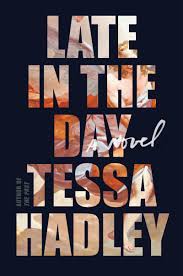 This weekend I got lost in Tessa Hadley’s brilliant new novel, Late in the Day. When I put it down to do housework I was unusually absent-minded. I flooded the dining-room table with teak oil as I pondered the relationships between the characters. If you know Hadley’s work you won’t be surprised, and if you don’t, Late in the Day is the perfect place to start.

 Some books are popular, others unknown. Karen Thompson Walker’s new science fiction novel, The Dreamers, has received almost too much attention, while Soviet writer Friedrich Gorenstein’s grim Redemption has received too little.
 Columbia University Press recently published the first English translation of Friedrich Gorenstein’s Redemption, which was written in 1967. Gorenstein, a Soviet Jewish author, left the Soviet Union and moved to Berlin to publish his work.
 Tempus fugit. Do you lament the paucity of time?