Tag Archives: Tessa Hadley

Angels of Books: Dixon, Haslett, & Zola

1
Photo by Debrocke/ClassicStock/Getty Images

“How I would love to be an angel of books!”

I love the sound of the word angel – from the Greek angelos (messenger) – and to an extent I am a “messenger” of books.

I admit, I do not keep up with the latest books. I am bewildered by the sheer number, and yet the same few books are reviewed in all the book pages. And they mostly sound wonderful. “Ms. X is an extraordinary writer,” or “Mr. Y has achieved a lyrical intensity …”

And yet often they disappoint. The late Stephen Dixon, who wrote his books on a typewriter, attributed this decline partly to technological changes. He said he could tell the difference between books written on typewriters and computers, and thought the typewriter better suited to creativity.

The National Award-nominated Stephen Dixon wrote on a typewriter

I have not, alas, kept my New Year’s resolution to read more new books. So far I have made it through only one new novel. Kudos to Adam Haslett because I actually finished his novel, Mothers and Sons! And, no, I did not love it, but it was a good read. In my book journal I am always a softie and give five stars to everything, but poor critically-acclaimed Haslett got only a four (very good) as opposed to the coveted five (stellar).

Here’s why you might like Mothers and Sons: it is a complicated delineation of a distant relationship between a gay man, Peter, an asylum lawyer in New York, and his mother, Ann, a former Episcopalian minister who becomes a lesbian and establishes a retreat center for women.

You would think the gay thing would strengthen the bond between mother and son, but it doesn’t work that way. Peter was traumatized in his teens by killing a friend during a fight; he has never recovered, and Ann minimized the incident and forbade him to talk about it.

As a result, he is a lost soul, a silent victim. He has never come to terms with Jared’s death, and has no friends, only acquaintances and co-workers. All day he prepares to go to court on behalf of illegal immigrants, doing tedious, repetitive interviews and trying to gather information (mostly hearsay) to convince the judge to give the clients asylum.

Peter’s personal life is empty and dreary, and the prose reflects this. So much of the book consists of dull, clipped dialogue with his clients, who have tragic stories and suffer from PTSD. Haslett captures the dreariness of listening to these stories all day, but Peter’s listlessness is also boring to the reader. I just wanted to have a laugh sometimes, but there was no relief in sight.

Here’s the good news: the style does liven up after 80 pages, when Peter reluctantly takes on the case of a gay Albanian client, whose situation, though more dire, was comparable to Peter’s. Haslett relaxes, the characters become more three-dimensional, and the Albanian guy does have a laugh occasionally, which improves Peter’s bleak world view..

I disliked the sections about Ann. She is a flat character, cold and serene – but mostly cold – and though she likes listening to the women on retreat, she is basically channeling her ministerial platitudes. She is almost too involved with people: her lesbian relationship has become routine so she has fallen in love with another woman. While Peter has no involvements, she has too many.

Ann wants to see Peter, but she cannot connect with him over the phone, and doesn’t try very hard, either. He never visits. His kooky sister Liz visits both Ann and Peter, and Liz wonders loudly why neither one is interested in her. (We wonder, too.) She is simply their interpreter. I do wish there had been more about Liz. She provides some color. Stylistically, this book is gray, if I had to pick a color, but there is hope at the end.

As for books I’ve loved this month: yes, they are classics. I enjoyed The Drinking Den, the seventh volume in Zola’s 20-book cycle of naturalistic novels, Les Rougart-Macquart, in which he studied the effects of heredity and the environment on one family.

Zola’s novels are steamy pot-boilers, erupting with sex, crime, politics, and poverty. In The Drinking Den, a struggling family is shattered by alcoholism. This was a best-seller in 19th-century France, and created such a scandal that Zola’s next novel, A Love Episode, was an uncharacteristically toned-down love story. Not as popular, though.

In many ways, I find The Drinking Den terrifying. It is a hyper-realistic portrayal of the illness wrought by alcohol, the loss of jobs, the inability to meet commitments, and in this case, starvation and death. The heroine, Gervaise, works as a laundress after her lover, Lantier, deserts her, and she struggles to support their two sons. After marrying her neighbor, the hard-working construction worker, Coupeau, she opens her own laundry business. This smart couple is climbing up the ladder of class, until Coupeau has an accident, ironically caused by their daughter Nana, who calls out to him when he is working on a roof. (In a later novel, Nana, she has become a high-end prostitute.)

But it is all downhill after Lantier, Gervaise’s ex-boyfriend, returns and lures Coupeau down the road to alcoholism. This is a grim novel, and yet Zola has what I call a “noisy” voice: the writing rips along and you cannot put it down even when you’re exhausted by the fall of the family.

Does anyone have any recommendations of new books? It’s still my New Year’s resolution…

Reading in Bed:  A History

It is a truth universally acknowledged, that a single reader in possession of a bed, must be in want of a good book.– Anonymous ( NOT Jane Austen)

I am a proponent of reading in bed.  Many are not. Some outlaw this practice.   One imagines the Moms for Liberty waving torches in front of houses where they have sussed out reading in bed.

Some readers find it cozier to listen to whale sounds before bed. They say it sends them instantly to sleep. Others apply numerous creams and moisturizers to their faces and arms and legs and then don a sleeping mask. Again they fall into immediate ZZZZZZs.

I regard reading in bed as a portal to sleep. Wherever I go, I proselytize its benefits. It puts me in touch with myself and the universe so I can make the transition to sleep.

The first book I read in bed was a mystery by Patricia Moyes, which I read one afternoon while waiting to go to Christmas dinner. It had a calming effect on an exciting holiday. Later, when I lived for several months with my father, I kept nocturnal hours and stayed up late reading Tess of the d’Urbervilles and Doris Lessing’s The Golden Notebook, tucked cozily in a sleeping bag on top of the bed (because what teenage bookworm ever makes the bed, right?).

As an adult I have devoted many evenings to reading in bed.   I recommend getting lost in a Victorian classic, such as Trollope’s The Way We Live Now;  Golden Age Detective fiction by Margery Allingham and Ellery Queen; Elizabeth Bowen’s lyrical novels; and the latest by Tessa Hadley, After the Funeral and Other Stories, many of which explore the theme  of living in a hippie family.  The characters and situations can be comical and poignant, but on one occasion, the hippie children are tragically resentful and unbalanced at their mother’s wedding.

Speaking of which, has anyone noticed that Tessa Hadley is never nominated for the Women’s Prize or the Booker Prize?  I find that unfathomable, since she is one of the best English writers today.  She has won other awards, doubtless prestigious but unknown to me.  I hope her next book wins one of the big prizes.

Reading is bed is such a comfort, but over a period of weeks I put the practice on hold, because my husband objected to my reading the Poldark books in bed.  He claimed my reading woke him up in the wee hours,  because I was clearly so enthralled by it.  (Can you hear silent enthralling?) Yet I couldn’t put the Poldark books down even for his sake, and if you’ve read Winston Graham’s well-written, dashing historical novels, you’ll know what I mean.  So I took to reading Poldark in the spare room. 

The prolific, multi-talented Winston Graham also wrote Marnie, which was adapted as a film by Alfred Hitchcock, starring Sean Connery and Tippi Hedren.  It is a gripping movie, simmering with terror, neurosis and repressed sex. There is an eerie scene between Marnie and her mother that haunts me.

As for Poldark, I admit that I have not finished the series. Someday I’ll get back to it. I love the complex characters and the vigorous writing. It begins when the charming, smart Ross Poldark, a veteran of the Revolutionary War and the part-owner of a couple of disused mines, returns from America to Cornwall only to find that he was presumed dead, and that Elizabeth,  his former fiancée, has married his cousin, Francis.  Naturally, Ross is moody and upset, though later, he marries Demelza,  a young woman he rescued from her violent father, and who grew up as a servant in his house, and who becomes a charming woman. But it takes a long time for Ross to properly appreciate Demelza, though she is a far more sympathetic character than the neurotic Elizabeth. Demelza is a skilled gardener, a sympathetic listener with many friends,  a good mother, and capable of lying to the British soldiers to protect smugglers. The repair of the mines owned by Ross and Francis requires a glib tongue (Ross’s) to acquire money to get them into shape. The working conditions in the mines are as humane as possible, unlike the horrific practices described in Zola’s Germinal or in Richard Llewellyn’s How Green Was My Valley. Still, there are accidents.

Lately I’ve reread lots of Henry James (The Ambassadors, The Spoils of Poynton), Mark Twain’s witty, inimitable novel, The Adventures of Huckleberry Finn, and a couple of books from the Booker International and Women’s Prize longlists. All of these are appropriate bedtime reading.

But if you really want to go to sleep, why not try something by Dumas? Anything by Dumas!  Oh, dear, I wish I loved his books, but I feel myself falling asleep at the thought of reading one.

ZZZZZZZZZZ…

Good night, all!

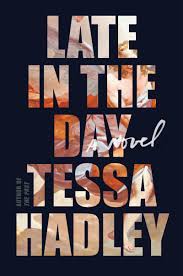
Tessa Hadley’s “Late in the Day”

This weekend I got lost in Tessa Hadley’s brilliant new novel, Late in the Day.  When I put it down to do housework I was unusually absent-minded. I flooded the dining-room table with teak oil as I pondered the relationships between the characters. If you know Hadley’s work you won’t be surprised, and if you don’t, Late in the Day is the perfect place to start.

This insightful, delicate novel is about four close friends in their fifties. It begins with a phone call. Christine and her husband Alex are listening to classical music in their London apartment when the landline rings. Christine answers, expecting to hear her mother or daughter.  But it is Lydia, her  best friend since childhood, calling to say her husband Zachary has died of a heart attack. And this is traumatic for all of them, since Alex and Zachary, both sons of immigrants, grew up together and were lifelong best friends. The two couples are very close.  And their adult daughters, too, grew up together and are close friends.

Relationships  are complicated, as you might expect. Are there too many pairs of best friends? Perhaps I liked it because it is so unlikely, and yet I didn’t doubt it for a minute. It’s all a bit incestuous, like something out of early Margaret Drabble. And the eroticism and sentence cadences are reminiscent of D. H. Lawrence. It’s The Waterfall meets Women in Love, for the middle-aged. It’s beautifully written, and it is also a page-turner.

Hadley goes back and forth in time to tell their stories. She is a master of this kind of storytelling—she  also does this in her superb  novel The Past. The characters in Late in the Day are much more sophisticated than anyone I know, but she makes us understand how they became these people.

In their twenties, Christine, a graduate student in English, and Lydia, a dilettante and femme fatale, met Alex at the university. He was their French teacher and a poet, and Lydia developed a crush on him. She was so obsessed with Alex that she more or less stalked him.  She got to know his wife, babysat for their child, and hung out at the bar where Alex goes. She dragged Christine along for credibility, so she wouldn’t look like a girl with a crush. But it doesn’t quite work out. Christine is impatient with Lydia’s obsession, and moody Alex has no sexual interest in Lydia.   Anyway, Christine marries Alex (after he leaves his first wife) and Lydia marries Zachary. And they are happy, and their lives interwoven.

Their professional lives are also fascinating. Christine gives up working on a Ph.D. on Christina Rossetti to become an artist. Alex stops teaching as an adjunct at universities and becomes an elementary school teacher. Zachary, by far the kindest, most charming character in the book, opens his own gallery in a church and displays Christine’s work. And Lydia slouches around being gorgeous without actually doing anything.  For me, Lydia is the problem–and yet I do know women like that!

Like Drabble, Hadley gives us lots of background on her complicated characters. Let me just say that their relationships become entangled after Zachary’s death. It will make you glad you’re unsophisticated, and at the same time you want to know these people.