
In France in the first quarter of the 20th century, Colette developed a huge fan base for her witty, lyrical novels, memoirs, and short stories. Marcel Proust, Andre Gide, and Jean Cocteau admired her work. Readers raced to the bookstores in Paris to buy the latest Colette after the success of the Claudine series: Claudine at School, Claudine in Paris, Claudine Married, and Claudine and Annie: Perhaps the race to the bookstores to get the latest Twilight book was comparable to the Claudine fandom.
Although some critics considered Colette’s work scandalous -and there is plenty of sexual innuendo – Colette wrote and spiced up Claudine at the behest of her first husband, Willy, who ran a ghostwriting “factory.” The books were (loosely) based on notebooks she had written in her teens. The series was published under Willy’s name, and after their divorce she sued for the copyright.
This series was so popular that there was Claudine “merch”: notebooks, sailor suits, dolls, and haircuts; Colette even did a touring act as Claudine. But Colette’s more discerning fans admire her subsequent, more sophisticated books. Some are lyrical, witty romance novels with a twist, because not every Colette heroine wants to marry – or autobiographical novels based on her own life and loves. Some characters are heterosexual, others gay or bisexual. In The Blue Lantern, Colette writes fluently about old age, as, crippled by arthritis, she lounges on her couch under “the blue lantern,” a lamp with a writerly blue stationery lampshade. (The Blue Lantern was her famous memoir of old age.)

But let us get on to The Vagabond, an exquisite autobiographical novel often acclaimed as her masterpiece. It can be read again and again with pleasure. (I’m on my second copy.) Enid McLeod’s graceful translation was published in 1955 and is still in print (FSG). A new translation was recently published by Oxford World Classics.
Based on Colette’s career as a music hall performer, this lively novel is full of humor and charm. In the following passage, she describes what it’s like to be backstage in a flimsy costume in a cold, unheated theater.
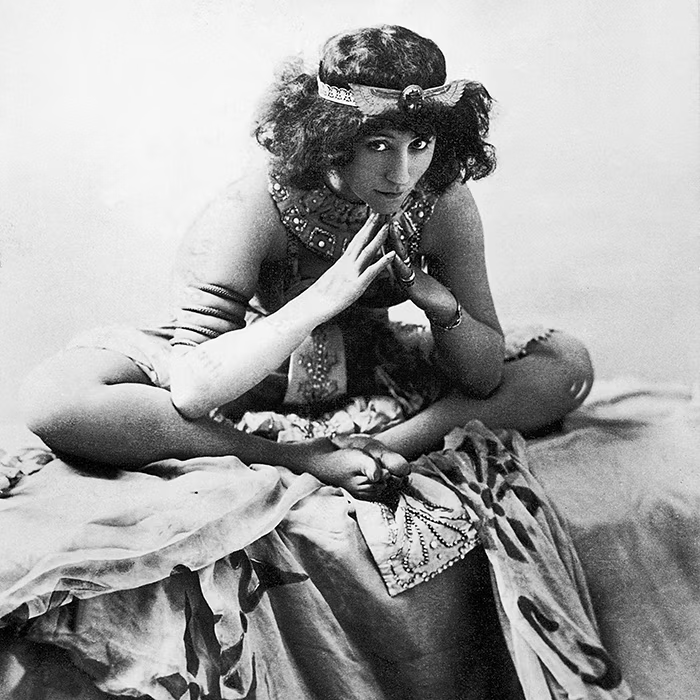
It’s absolutely freezing in here! I rub my hands together, grey with cold under the wet white which is beginning to crack. …on Saturdays here they rely on the high-spirited popular audience, rowdy and slightly drunk, to warm the auditorium.
Colette wrote The Vagabond while on a music hall tour: she wrote on trains, at depots, and between acts. And it was on tour that Colette met Auguste Heriot, the rich heir of a department store owner. He wooed her with flowers in her dressing room, and was the model for Big Noodle in The Vagabond. Big Noodle, who falls in love with Renée, Colette’s fictional counterpart, also brings flowers to Renée’s dressing room. The difference is that Auguste was much younger than Colette, while Big Noodle and Renée are the same age, 33.
Like Colette, the divorced narrator Renée becomes a music hall performer. Like Colette, Renée has no interest in her gentlemen fans. But one day while chasing her dog, Fossette, in a park, she hears heavy breathing behind her. When she turns around, she sees Big Noodle, who, despite her rejection of his advances, is determined to win her affections. He is sweet, but is not the brightest of men. In the following passage, we think of Apollo huffing and puffing as he stalks/chases the nymph Daphne
“I followed you… I was careful to run at the same pace as you so that you shouldn’t hear my steps. It’s quite simple. “
Yes, it’s quite simple. But it had to be thought of. For my part I shouldn’t have thought of it. Provoked and imprudent, a nymph-like brutality took possession of me and I laughed full in his face, defying him…
Renée is serious about her wish for independence. But was Colette? Well, she once laughed and said that her heroines were more courageous than she was. This is more or less like saying, “Do as I say, not as I do.”

As for Colette, she married three times. Between marriages, she had boyfriends and girlfriends. But her combination of humor, witty dialogue, contemplation, and poetic sketches of nature make her one of my favorite writers of the 20th century (and now the 21st).