Tag Archives: Charlotte Bronte

Books to Get Us through the Decades

Time is a a capsule. It’s a bomb, it’s a card. My 1980s Webster dictionary uses two columns to define time, but what we need is Einstein. 

The time card

 Pop culture defines time in terms of decades and generations:  the ’80s, the ’90s, the 2000s, as if specific trends can define a time period; and then there are the randomly assigned generations, the Silent Generation, Baby Boomers, Gen X, Millennials, and Gen Z, who may or may not be accurately described by eager sociological journalists.

Because of the internet, we’re always in a rush, comparing ourselves with people on social media who read 300 books a year. But Festina lente (“Hurry slowly”), as Augustus said. Speed is not the essence. Why not devote a week or a month to reading a classic?  It is the reading, not the numbers, that matter. And great literature does help you slow down time.

Anyway, forget about the clock and the card. Below is a list of books that take you out of time.

The Golden Notebook, by Doris Lessing, an experimental novel about the fragmentation of women’s lives in the 20th century.  Anna Wulf, a blocked writer, experiments in her notebooks with barely fictionalized accounts of her life, ranging from her years as a communist during World War II in Africa to her literary success in London and affairs with mostly married men.  The book is tied together by intermittent scenes in which  Anna and her best friend, Molly, an actress, discuss their lives as “free women.”

Anything by Charlotte Bronte.  Start with Charlotte Bronte’s Jane Eyre (governess falls in love with Mr. Rochester but learns he has a mad wife in the attic), and then on to Villette, her best book, in which mousy, unemployed, penniless Lucy Snowe desperately travels to Belgium to seek work and finds a job as an English teacher. But the creepy headmistress spies on her, a fussy Catholic domineering male teacher becomes obsessed with her, and she falls in love with a doctor who does not find her attractive: he regards her as a friend. Much edgier than Jane Eyre, plus two psychedelic scenes, one of which occurs at night after Lucy is drugged by the headmistress.

Two Novels by Margaret Drabble.   I am a great fan of Drabble, and especially admire her early work. My two favorites, published respectively in 1972 and 1975, are The Needle’s Eye and The Realms of Gold. 

In The Needle’s Eye, set against a sophisticated sociopolitical background, we meet Rose, an idealistic heiress who gave away her millions to live ethically in a slum with her children. An unhappily married lawyer meets Rose at a party, and falls quietly in love. But this is not a love story.

In The Realms of Gold, Drabble again explores class and politics. Frances, a celebrity archaeologist and single mother of four children, left the provinces and invented a new life. Her career flourishes, but she suffers intermittently from depression, and has lost touch with her lover, Karel, a frazzled community college professor: a lost postcard delays their reunion. Frances also counters depression by daring to explore her roots, revisiting her unattractive hometown in the Midlands, recognizing the good and bad of the past. And part of the narrative is devoted to Frances’ second cousin, Janet Bird, a housewife with no real education or options. But for the grace of God… Time and place matter.

Anna Karenina, by Leo Tolstoy.  Anna Karenina, the most sympathetic adulteress in literature, ironically falls in love with handsome Vronsky on a trip to Moscow to negotiate peace between her adulterous brother and his wife, Dolly. A huge cast of characters is affected by the affair of Anna and Vronsky, including Kitty, Dolly’s younger sister, who had thought that Vronsky would propose to her, and Levin, a landowner rejected by Kitty because of Vronsky’s flirtation. And then there is Anna’s successful but unattractive husband, Karenin, who loses the respect of colleagues because of the stigma of his wife’s adultery. Karenine punitively forbids Anna to see their son, which devastates both mother and her son. 

I once read an essay by (or interview with?) Ian McEwan, who said that as he grew older he wondered how much time he had left to reread Anna Karenina. The late novelist Robert Hellenga said that he reread AK every year. I can’t compete with that, but I have read it more than once.

So these are some of my favorite books that do seem to slow down time when I read them. Do tell me about any absorbing books that do the same for you!

Physical Appearance in Charlotte Bronte’s “Villette”

Charlotte Bronte’s most popular novel is Jane Eyre, but Villette is by far her most complex, and my favorite. This near-psychedelic maze of a novel charts the narrator Lucy’s survival in a foreign country, her challenges as a working woman, and the price of solitude – illness, hallucinations, and mental breakdown – when she lives alone at the school during the two-month vacation. Not all readers like quiet, reserved Lucy,: in fact, Elizabeth Gaskell told Charlotte that she disliked Lucy.
.
And yet I don’t see her as cold or dull. Lucy is a sweet but deeply flawed woman defined by a fierce intelligence, Protestantism, quiet charm, and hidden passion. She is not without bitterness, but that is born of circumstances and poverty. In the 19th century she navigates the uncertain career path of an unskilled woman. Marriage is one of life’s goals but not for her: with her parents’ death she fell out of the middle class into poverty.

it is not entirely different today: single women in our society are expected to marry, and often face a brutal struggle to find a “mate,” as opposed to bad blind dates. (Jill Bialosky writes about this in her brilliant memoir, Poetry Will Save Your Life.) Many women, like Lucy, still live on bare-bones salaries, because women’s salaries tend to be lower than men’s. Lucy is lucky to find a teaching job, but must live in the dormitory of the school. The students are rich; the teachers, ironically, are very poor, and cannot afford a home. But Madame Beck, the headmistress and owner of the school, values Lucy’s teaching and treats her like an equal.

In her twenties, Lucy has not given up on marriage; she has never dreamed of it at all. As an exceptional teacher at a girls’ school in Villette (Bronte’s fictional name for Brussels, where she herself went to school and taught for a few years), Lucy is a realist about her situation. But she is surrounded by talk of marriage. Her fellow teachers and her students dream about love and marriage. She knows it is unlikely that her colleagues will have the opportunity to marry.

But, first and foremost, Lucy’s plain appearance defines her in people’s eyes. Is she as homely as she thinks she is? This is not a problem for Charlotte Bronte’s other heroines. In Jane Eyre, Jane attracts the rich, rakish Mr. Rochester. In Shirley, Caroline and Shirley are both attractive, and both marry attractive men. Lucy does not value looks, but at the same time knows that her future might be different if she were better-looking. Eventually she does have a boyfriend. More later, but a hint: she might be better off without.

Villette, TV series 1970

At the school, different classes of women – the students being the upper class, the employees the lower – have completely different expectations in terms of beauty and fashion. The students are well-dressed, but Lucy cannot afford fashionable clothing, nor does she wish to wear it. She is mousy, and her dresses are gray. She considers a simple, light pink dress, given her by her godmother, almost too bold to wear in public. She wants to disappear into the woodwork, to be unseen.

Contrast this with one of her students – a beautiful, vain English girl, Ginevra Fanshawe– who constantly talks about her clothes and her two boyfriends, whom she plays off against each other. Ginevra has persuaded one of her suitors – the one who can’t afford it, Dr. John – to give her gifts of of clothing and jewelry. She also regards her rich uncle as a bank. But however much Ginevra has, it is never enough. Fashion leaves her ravening for more.

Although Lucy finds Ginevra exasperating, Dr. John, the school doctor, is madly in love with her. Lucy learns all about it when she has a nervous breakdown, collapses on a street at night, and is discovered by Dr. John and a priest, who take her to Dr. John’s house to recover. And there she meets her godmother, Mrs. Bretton: it seems that Mrs. Bretton and her son, Dr. John, lost their money and moved to Villette, where John’s medical practice is thriving. Lucy and Dr. John become close friends, but he constantly praises Ginevra, and talks about how much Lucy must like and admire this sweet, naive girl. His delusions irritate her, and at one point she snaps at him. She has a sharp tongue, and his feelings are hurt.

But at a concert hall Lucy has a rude awakening: she is plain, perhaps plainer than she’d thought. She sees three fpeople walking toward her, and it turns out it is the reflection in a a mirror of the Brettons and herself: she is startled and disappointed when she recognizes herself in the pink dress. She had hoped that perhaps it would transform her, but no. And she has strong feelings for Dr. John, who does not return them. At one point he says that if she had been a boy they would have been brothers, friends who agreed about everything.


Eventually Lucy does have a boyfriend: an “absurd little man,” as she calls him, who teaches at the school. M. Paul is a fanatical Catholic. Educated by Jesuits, he spies on Lucy and others at the school. He goes through her drawers. He constantly harangues her and criticizes her. He reduces both Lucy and his students to tears. People are terrified of him, though Lucy staunchly ignores him when he oversteps. As the book goes on, he finally shows kindness to her.

Will Lucy marry him? Or not?

Parts of Villette are loosely – very loosely – autobiographical. Charlotte taught at a school in Brussels and fell in love with the married headmaster. But neither Emily nor Anne married, and Charlotte married a curate only after her sisters’ deaths. Charlotte died a year after her marriage of an intestinal infection while she was pregnant.

A New Book for the Bronte Collection

Charlote Bronte’s Shirley, Folio Society 1968

People say I buy too many books. Of course I buy books. I read them, too. “Do you need more library books?” a friend asked. She was ready to do an intervention. I could feel it.

“Oh no.” I was kind of appalled. “I just love books!” And then I blurted out, “I collect books.”

And that changed everyone’s perception. I’m not “just” a reader, I’m a collector! And books are much less expensive to collect than cars (one for every household member, it seems), iPhones, food, tickets to plays, movies, concerts, etc.

frontispiece of Shirley

For instance, a book came in the mail today. It is an illustrated Folio Society copy of Charlotte Bronte’s Shirley, published in 1968. It was very cheap: under $10. And I bought it for the gorgeous lithographs by Walter Hoyle.

Shirley is relatively rare, as Bronte’s books go. This sprawling industrial novel never caught on with readers or critics. Fascinated by the Luddite riots in 1816, Bronte did an enormous amount of research before she carefully delineated a clash between the workers and a cotton mill owner in Yorkshire. However, most of the novel revolves around the friendship between two women, a wild heiress and a quiet vicar’s daughter. And the impetuous Shirley was based on Emily Bronte, who died before Charlotte finished the book.

The Bronte Set: Penguin Clothbound Classics

It is easy to find a paperback edition of Shirley: Penguins, Oxfords, and Wordsworths. But I was disappointed that Shirley is not one of the titles in the Penguin hardcover classics collection.

Could I find a comparable hardcover edition? I asked. Well, I was browsing on the internet, and found this one.

Another “collectible” reading copy! I couldn’t be more pleased.

The Villette Rebellion

Penguin hardcover classic

I have a Villette book bag.

I designed and ordered a unique Villette bag from a personalized wedding paraphernalia website. I love to tuck a copy of Charlotte Bronte’s Villette into the mysteriously-named bag. (Villette is Bronte’s fictional name for Brussels, the city where she studied, taught, and fell in love.) On my first trip to London, Villette was my comfort book. When I got lost in Green Park (at least I think it was Green Park), I read Bronte to calm myself. Like Lucy Snowe, I had to ask directions.

Villette is the best kind of spinster lit. You don’t have to be a spinster to love it. The heroine Lucy Snowe’s story still appeals after many readings. She is witty and funny, as well as intense. The destitute Lucy surprises herself when, after the death of her employer, she dares to spend her last money traveling to Belgium alone. There’s nothing left for her in England. And in Villette, by the barest chance, Lucy reinvents herself as a brilliant English teacher.

This marvelous book is partly a realistic examination of love and work, and partly a Gothic novel with supernatural manifestations. In a couple of scenes, Lucy sees what may be the ghost of a nun; and there is a long hallucinatory scene after her rival administers a drug to her so she won’t be able to meet M. Paul, her potential lover. And so it’s a very modern book published in 1853: “Tune in, turn on, and drop out,” said Timothy Leary in the ’60s. Bronte in detail describes Lucy’s drug experience. Lucy would, however, never drop out. Lucy hangs in there. She might have liked the ’60s.

My much-read Penguin hardcover of Villette and my cheap on-the-road Wordsworth paperback.

It used to be difficult to find copies of Villette, so I was delighted when Penguin published a hardcover edition in 2016. It has the same introduction and notes as the paperback, but the paper is of a much higher quality. However, I may have read this poor book almost to death. Do the leaves in the middle and on the right side look as though they are fading away? I fear that this gorgeous book has suffered from outings in the Villette bag. I need to pay it more respect.

One of the nicer Wordsworth covers, but it has been replaced several times, and as you can see mine (above) is different.

I now have a backup plan for traveling with Villette. I bought one of the cheapest copies I could find for reading at cafes, outdoors, or on the road: I recommend the Wordsworth edition ($4.95) or a Signet ($4.71). Although all my books are reading copies, paperbacks don’t have to be in pristine shape. I have no conscience about carrying this in my Villette bag. If it gets slightly scrunched, so be it.

Are you a Villette fan? And what edition do you have? And do you have multiple copies of any of your favorite books?

The Fate of a Genteel Career Woman: Lucy Snowe in “Villette”

In Charlotte Brontë’s Villette, the narrator, Lucy Snowe, a poor, genteel young woman, is lucky to find a job teaching English at a girls’ school in Villette (a fictitious city based on Brussels).   

Brontë’s masterpiece, Villette, is a dark take on her more popular novel, Jane Eyre.  Like Jane, the penurious Lucy is an orphan.  She is plain. She has no relatives or connections. And the  kind old woman to whom she was a paid companion has died.

Most of the women characters in Villette – all except the teachers and servants – have the opportunity to  marry. As for Lucy, her prospects of marriage are scant.  Remember Newsweek’s notorious claim in 1986 that women over 40 were “more likely to be killed by a terrorist than find a mate”?  This famous line was not based on statistics – it was printed to sell magazines – but much the same thing was probably gabbled in the 19th century about poor genteel English women over, say, 20.  Lucy is only 23, but seems doomed to spinsterhood.  (The sell-by date was younger then.)

Like modern women, plain or pretty, Lucy lived under the shadow of this future Newsweek scare.  Unlike the heroines of BBC costume dramas, she would not be discovered at a ball or weekend party by a dazzling, charming, preferably rich gentleman.  Lucy wishes she could marry and have a home, but knows how unlikely it is.

Modern women have the same problems.  As for the marriage prospects of single or divorced women in the late 20th century and the zips, we cannot pretend they were sanguine.  Love scenes did not unfold like a Netflix comedy:  you would not meet the ideal man at a club, i.e., a dimly-lit, gritty warehouse with black walls, loud bands, and terrible acoustics, nor would you metamorphose into Meg Ryan and end up with Tom Hanks in Sleepless in Seattle.  And the darling friend who urged you to place a personals ad was a fantasist:  she was sure you could meet the owner of a baseball team (“We’re not Jane Fonda!”), the director of an orchestra (dubious, as we did not listen to classical music)  or the wealthy director of a private charitable foundation (our reaction was blank, because we couldn’t imagine such a person).              

Single, solitary Lucy courageously travels to Belgium, thinking it will be an adventure and that she might as well starve there as in London.   Arriving in Villette at night, she has two experiences with men, one comforting and the other terrifying.  An English gentleman gives her directions to an affordable hotel and accompanies her part of the way; but then she is stalked by two intimidating men, runs away, and ends up serendipitously in front of the school where she finds a job. 

And so Lucy becomes a career woman.  She has 60 students in a class, all of whom are ready to rebel at any sign of weakness.  She establishes her dominance on the first day by pushing an unruly girl into a cabinet and locking her in.  This is not an acceptable practice, of course,   but even the other girls empathize with Lucy, because they dislike the troublemaker and respect Lucy for quelling a riot in her class.  (Ah, this would make a great film, like Up  the Down Staircase, The Emperor’s Club,  To Serve Them All My Days, To Sir with Love, and maybe even Bad Teacher!)

Much is made of Lucy’s quietness, her grey dresses, her uneasiness when she is given a pink dress, and her general invisibility.  

But she isn’t quite invisible. By chance, Lucy meets and falls in love with Dr. Graham, a young doctor who is called in when the girls at school are sick.  He likes Lucy  – he saves her life when a priest finds her collapsed on the street with delirium and illness – but he certainly doesn’t love her.  When Lucy regains consciousness, she is in a bed in a strange room, and yet not totally strange, because she recognizes the furniture of her godmother, Mrs. Bretton.  Lucy learns that Mrs. Bretton has  moved to  Villette and that Graham is her son.  And so Lucy becomes their pet and is frequently invited to concerts and theater.

But Lucy is Graham’s pal, not his girlfriend.  He confides in her about the two women he falls in love with.

It is difficult to maintain the role of buddy, and it doesn’t help that Graham regards her as the perfect friend. 

At one point Graham says,”I believe if you had been a boy, Lucy, instead of a girl – my mother’s god-son instead of her god-daughter -we should have been good friends:  our opinions would have melted into each other.”

Basically he is saying they are soulmates, but he doesn’t want to think of her as a woman. Later, she wonders if  Graham would have regarded her differently if she had had money or was of a higher class, like the two women he falls in love with.

Perhaps Lucy is more attractive than she thinks.  She has a suitor, M. Paul, the literature teacher at the school.  He is ugly, bossy, histrionic, snoopy – he goes through her desk – and I find him exasperating, even though he gives her books and chocolates.  Lucy finds him ridiculous at first, but gradually comes to appreciate his good qualities.  He is definitely second-best.

Villette is a brilliant novel, with a surprising ending that shows you Charlotte doesn’t always aim to please.  This novel isn’t exactly about work, or love, or triangulation (so many triangles!), or marriage:  it is a portrait of the messy, scraped-togethr lives of poor, genteel women in the 19th century.

“Shirley” by Charlotte Bronte: Romance and the Industrial Revolution

Writers’ museums are enjoyable, yet boring. I considered traveling from London to Haworth, The Bronte Parsonage Museum, but it seemed too complicated, and would probably be  too touristy anyway.  Even the Dickens Museum is too touristy.  There are do’s and don’ts:  don’t linger in Dickens’ dining room, because you will not want to see plate settings labeled John Forster and Thackeray.  It is also, if I remember correctly, a  talking dining room, with a loop of The Pickwick Papers set on “forever.”  Do go upstairs and look at Dickens’s desk, specially designed for his readings.  I love the upper floors of the Dickens museum
 

I fear that Haworth’s dining room might recite Jane Eyre.  In fact, the only writers’ museums I can honestly recommend are in Nebraska:  Willa Cather’s in Red Cloud and Bess Streeter Aldrich’s in Elmwood.

The Bronte Parsonage in Haworth, West Yorkshire


Charlotte Bronte is, of course,  best known for Jane Eyre and Villette, both masterpieces, while her novel, Shirley, which she finished in 1849, after the deaths of her siblings Branwell, Emily and Anne, is unfairly overlooked. 

Shirley is an entertaining, well-written, serious book, if wildly uneven.  One gets the feeling that the mourning Charlotte lost her sense of form when she went back to writing Shirley.  It begins as an industrial novel, set in Yorkshire, centered on the clash between workers and manufacturers in 1811.  But soon it turns into a romance, and a fascinating study of women’s depression.

Bronte begins by introducing us to a a comic trio of  curates.

Of late years, an abundant shower of curates has fallen upon the north of England: they lie very thick on the hills; every parish has one or more of them; they are young enough to be very active, and ought to be doing a great deal of good.  

And then we meet Mr. Helstone, a well-respected, crusty clergyman, who interrupts the curates’ party, and commands Malone, his Irish curate, to accompany him to Robert Moore’s mill.  Moore expects trouble: he has ordered new machinery to be delivered. And many of his out-of-work employees, whom he has fired because of a trade embargo during the Napoleonic Wars, are militant.  And indeed there is violence:  the wagons are stopped and the machinery broken.

I am fond of Victorian novels about industrial change:  I love Elizabeth Gaskell’s North and South, a masterpiece, and Mary Barton.  In fact, Charlotte was worried when Mary Barton was published before Shirley, in case it affected sales and reviews.

But never mind:  Shirley is not entirely an industrial novel.   Bronte abruptly changes tack  and focuses on the heroine, Caroline Helstone, an intelligent young woman who has been brought up by her unaffectionate uncle, Mr. Helstone.  He wrecks Caroline’s happiness when he forbids her to spend time with  Hortense Moore, Robert Moore’s sister, who is teaching her French, mathematics, and English literature.  The Moores are Caroline’s Belgian cousins. Mr. Helstone fears that Robert may want to marry Caroline, for the little money she has.  (Mr. Helstone miscalculates:  there is not enough money for cold, calculating -yet supposedly lovable- Robert.)

Caroline in solitude changes overnight from a charming, lively woman into a depressed, mousy, miserable girl.  Caroline is completely alone, so she follows a schedule, studying, doing good works, and exercising every day.  She tells her uncle she would like to go away find a position as a governess.  He is angry, because of class reasons:  Caroline will never have to work, he says, and he will not allow it.  


But what is Caroline to do in the village?


We do not meet the heiress, Shirley Keeldar, until page 203 (the Everyman’s Libray edition).  And so I cannot seriously regard Shirley as the heroine and think the title is a misnomer. The heroine is Caroline, and that should be the title.

But Shirley’s move to Fieldhead saves Caroline from despair. The two become best friends, yet Caroline still longs to go away and work.  And, because she pines for Robert (and has no work) she becomes very ill and falls into a terrible depression. 

I thoroughly enjoyed this odd book.  Yes, it rambles, but Charlotte Bronte is brilliant, witty, and is one of the best – perhaps the best – writers of the 19th century. 

I don’t know the history or politics, but Bronte takes the side of the mill owners, because they cannot compete internationally unless they mechanize; yet she is fair to the unemployed mill workers and their starving families on a personal level. 

A Psychological Bildungsroman: Love and Morals in Charlotte Brontë’s “Jane Eyre”

“Jane Eyre isn’t exactly chill,” a friend said when I admitted Jane Eyre had lifted my mood.

Any shade of “chill” I ever attained has been erased by the struggles and weariness of the pandemic.  This month, I fell off the chill charts and climbed to the far edge of the intense Jane Eyre “spectrum.” Charlotte Brontë’s classic, Jane Eyre, is one of the most intense Gothic romances of the 19th century. Charlotte’s Villette is a better book, but Jane Eyre is certainly the most popular.

For most of us,  Jane Eyre proves a role model after we outgrow Little Women and Anne of Green Gables. Like Jo in Little Women and Anne (of Green Gables), Jane is intense, intelligent, passionate, ethical, honest, and has moral vision. Jane Eyre is the best of these three books; indeed, it is a perfect book.  Jane argues ethics with an intensity her fictional sisters can’t match. But what Jo and Anne have, and Jane lacks, is humor.

Charlotte Brontë herself had a sense of humor: consider the scintillating remarks of Jane’s dark, witty, worldly suitor, Mr. Rochester. The following exchange is typical.

“I only remind you of your own words, sir:  you said error brought remorse, and you pronounced remorse the poison of existence.”

…”Once more, how do you know?  By what instinct do you pretend to distinguish between a fallen seraph of the abyss and a messenger from the eternal throne–between a guide and a seducer?”

This is my copy: the Heritage Press edition (1974)

Rereading Jane Eyre is the best idea I’ve had in months. It is a book to get lost in–and I began it on a gloomy, rainy day, like the one Jane describes on the first page. “There was no possibility of taking a walk that day. We had been wandering in the leafless shrubbery an hour in the morning; but since dinner (Mrs. Reed, when there was no company, dined early) the cold winter wind had brought with it clouds so sombre, and a rain so penetrating, that further outdoor exercise was now out of the question.”

Brontë’s detailed account of Jane’s psychological coming-of-age follows her from an orphan bullied by her sadistic cousin John at Aunt Reed’s house, where Jane has reluctantly been given shelter; to Lowood School, a charity school for girls, where the teachers try hard but the students are starved by the appalling minister, Mr Brocklehurst, until a typhus epidemic kills the majority of students.  After Lowood is reformed, Jane becomes one of the best students, and then teaches there for two years.
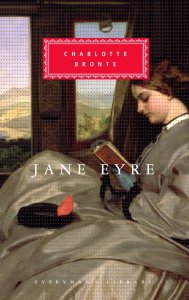
But girlhood–even the extended girlhood of teaching at one’s old school–must end eventually, and Jane decides to leave when the head of the school, Miss Temple, gets married. Jane advertises in the paper for a position and becomes the governess at Thornfield Hall.

Jane is a happy governess–unlike the narrator of Agnes Grey, the autobiographical novel by Charlotte’s sister, Anne Bronte. Jane enjoys teaching her flighty charge, Adele, the daughter of a French dancer and possibly an illegitimate byblow of Mr. Rochester’s–and Jane and the housekeeper, Mrs. Fairfax, become close friends.

When Mr. Rochester comes back to Thornfield Hall, there are conversations and parties. Brilliant, witty, and ugly, he is not the typical hero. But he and Jane, a plain, small, thin 18-year-old, spar back and forth and fall in love. Like Mrs. Fairfax, who says Rochester is old enough to be Jane’s father, we wonder if he’s a father figure. And yet this age difference is so common in 19th-century novels:  think of Emma and Knightley, who we assume will be happy when they marry. But then, of course, there are novels by Trollope, such as The Way We Live Now and Phineas Finn, in which an age difference in marriage has a bad psychological effect on a woman (Lady Carbury and her older husband; Laura Kennedy and Mr. Kennedy).

Lithograph by Barnett Freedman, “Jane Eyre” (Heritage Press)

Jane and Rochester believe they will be happy. And then–what could be more Gothic?– their wedding is interrupted at the altar, because someone testifies that Rochester is already married.  Rochester is forced to tell the story of his mad wife Bertha, who is locked up in the attic (from which she occasionally escapes to set Rochester’s room on fire or to rip up Jane’s wedding veil). Rochester’s well-told story is as mesmerizing as the best short stories of the 19th century. But on this reading, I noticed for the first time that Rochester admits Bertha sometimes has “lucid” spells for weeks at a time. It’s a small detail–but it does help us understand why Jean Rhys wrote her novel Wide Sargasso Sea from the point of view of Bertha. (I do not particularly admire Wide Sargasso Sea, but I do admire Rhys’s other novels and her autobiography.)

This time around, I am also appreciating the final part of the novel, when Jane leaves Rochester, starves and faints, and meets St. John, the rigid minister, and his lovely sisters, Diana and Mary. These scenes are very quiet after the excitement of Thornfield Hall. And yet I am fascinated by Jane’s new job, as teacher at a village girls’ school, where many are illiterate.  The idea of “doing good”  instead of being a pampered governess, or a beloved wife at Thornfield Hall, is preeminent.

In Jane Eyre, some characters are obviously  based on Charlotte’s family. Diana and Mary are Charlotte’s sisters, Emily and Anne Bronte. And at Lowood, Jane’s friend and role model, Helen, who dies of consumption, seems to be based on one of Charlotte’s older sisters who died at school. (N.B. I haven’t read a biography of Charlotte in years, so I am a bit fuzzy about this point.)  As for Rochester, he seems far too passionate anr rakish to correspond to any lover in Charlotte’s life, and St. John too fussy for a love object (though handsome).  But Charlotte was madly in love with  a married teacher/headmaster of a school in Brussels where she taught. (He is portrayed as M. Paul in Charlotte’s Villette.) Perhaps Charlotte decided to mix up a little Byron with the headmaster.  Why not?  It’s fiction.

Jane Eyre seems to ask, What is the best direction to take in life?  The ending is unexpected–not at all romantic, in my view, though many find it so. Jane has more determination and fearlessness than most women, as she proves as the Gothic grows more Gothic than Gothic in the final scene.   Jane’s moral decisions make us think we could run away to face poverty, hunger, and loneliness for the sake of goodness.

For Jane, it’s more than that.  Rochester broke moral and actual laws.  A happy ending or a sad ending?  It’s strange.  You decide.