Tag Archives: Guy Gavriel Kay

Summer Reading: Guy Gavriel Kay’s “Written on the Dark”

Joy.  Safety.  They can be present for us, more often are not.” — Written on the Dark, by Guy Gavriel Kay

In Guy Gavriel Kay’s brilliant, beautifully-written new novel, Written on the Dark,  he deftly infuses the narrative with bits of verse and philosophy. The book is part literary fantasy, part historical novel, set in a reimagined Middle Ages.

Kay, a prize-winning Canadian writer, is difficult to classify. He won the World Fantasy Award in 2008 and was named to the Order of Canada in 2014.  Despite the ghettoization of SF/fantasy, his work has been reviewed in The Washington Post and The New Yorker. And that automatically wins him a larger audience.

The Library of Congress, however, categorizes Written on the Dark as “Fantasy fiction./ Novel,”  and, indeed, it is both. You will find it in the SF/fantasy fiction section at the bookstore, but it could easily be shelved in the literature section, with Kurt Vonnegut, Alice Hoffman, and Yoko Ogawa.  Then our favorite snob friends might read it.  Of course, the reverse is also true: the fantasy fans wouldn’t be able to find it.

I assure you, this is not a “romantasy”.  Perhaps the word for it should be “histori-antasy.”

Kay’s fantasy novels are rooted in history and often inspired by poetry. My favorite of his novels, Under Heaven, was inspired by the poets of the Tang Dynasty.  Written on the Dark, set in a beautiful city, Orane, in an alternate Middle Ages, has been decimated by the Plague, but is slowly recovering.  This is, however, a time of social unrest. Thugs are abroad in the city at night, and there are political plots afoot.

Most of the main characters are based on historical personages. The protagonist, Thierry Villar, a raucous, satiric, witty tavern poet, is based on the poet Francois Villon in medieval France. And, yes, you may see a bit of  Christine de Pizan in the character Marina, a successful female poet. Other characters are based on Joan of Arc, Henry V, and the Burgundian duke Fearless John. In the Acknowlegements, Kay recommends several volumes of poetry, history, and biographies he read while researching the novel.

This vigorous novel is plot- and character-driven. It brims with excitement: it starts as a murder mystery.  One dark night a brutal murder occurs. Thierry is coerced by the Provost and other Guards to help investigate the murder of a powerful Duke. In the investigation that follows, it is Thierry’s job to talk to common people in shops and taverns and report back what is being said. He is smart and cunning, but not a cop: he runs into danger.  Eventually, he must flee for his life, but resents being in the country. So he finds more trouble when he insults his host, a rich poet, at a large dinner party: he tells him that he has no talent. Thierry is thrown out of the house, and encounters yet more trouble. All he wants is to return home to the city.

Kay describes the city of Orane, beloved by Thierry, who hates living outside the city limits. The novel begins in winter.

The city was harder to love in the dead of winter, easier when spring came.  Very easy, in fact. It was a glory of the world, Orane.  Fewer people than it had held before the worst years of the Plague – which was why there were places with young trees and open meadows in the walls. But it was growing again.

And there is much more about the city, but you’ll have to read the book.

Such an entertaining read! Perfect for August. I hope you’ve been enjoying your summer reading.

Any great summer books to recommend? I will dutifully try to round up some of the better ones I’ve been reading soon.

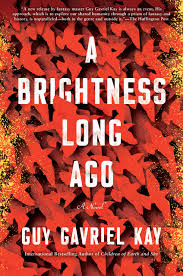
A History and a Haunting Novel:  Orlando Figes’s “The Europeans” and Guy Gavriel Kay’s “A Brightness Long Ago”

It is a rare experience to read two brilliant books in a row: a perfectly-imagined or well-researched book tends to be followed by the reading of a string of mediocre books.  Perhaps our brains cannot deal with too much excellence?

But I have been thrilled by Orlando Figes’s The Europeans:  Three Lives and the Making of a Cosmopolitan Culture, and Guy Gavriel Kay’s haunting new novel, A Brightness Long Ago.  

Fans of the great Ivan Turgenev will love Orlando Figes’s The Europeans, a sparkling, exuberant  history of the development of European culture in the the 19th century.  The book focuses on the relationship between the Russian writer Turgenev and Pauline Viardot, the opera singer he loved for most of his life, and her husband, Louis Viardot, a theater manager and writer.  This trio was influential in promoting the work of their peers, international writers, musicians, and artists .  (N.B. I  adore Turgenev and binge-read his  books in 2017 .  I blogged about it at Mirabile Dictu, if you’re interested.)
Whether or not the lovesick Turgenev and the controlling Pauline consummated their relationship–some vote for the Platonic theory, Figes gives evidence for a sexual relationship–Turgenev followed Pauline around Europe and rented apartments near the Viardets in Paris, Baden-Baden, and London. (Sometimes he lived with them.) As international commerce was facilitated by the building of railroads, Turgenev and the Viardots promoted the arts throughout Europe, Russia, and England. 

The craze for novels in translation became a big business for publishers, especially in France and Russia.  (The English were content with their own novels.)  Turgenev championed the Russian translation of Flaubert, the French translation of Tolstoy’s War and Peace, and the Russian translation of Zola, to name a few of his more famous projects.  Pauline,  one of the most powerful stars of the opera world, influenced the taste of composers (she sometimes helped them with their operas) and concert-goers.  And Louis Viardot, who for a time had managed his wife’s career, also wrote about radical politics.  (The French police  found them suspicious and spied on them.)

Turgenev became a beloved writer, especially in Europe, but had his emotional ups and downs, complicated by what often seemed like a one-sided love affair, bouts of gout, and being a considered a dissident in Russia.  (He was arrested in Russia after writing Gogol’s obituary.) I loved reading about Turgenev’s artsy social circle, the rise of art museums, the influence of critics on popular taste, and more.

Guy Gavriel Kay is in top form with his new novel, A Brightness Long Ago.  This gracefully-written historical fantasy, set in a world that parallels the city-states of Renaissance Italy, is a ripping-good read, brimming with politics, warfare,  and intrigues. And in the Acknowledgments, Kay recommends a staggering number of books that helped him with research, and explains that one subplot of the novel is based on the feuds between the Montefeltro and Malatesta families in 15th-century Italy. 

  A Brightness Long Ago is not quite in the same class as my favorite of Kay’s novels, Under Heaven,, but if you need a good cry, this is the book for you.  (I rarely cry over books, but I cried excessively over this one.)

What if you want to be a bookseller but the world takes you elsewhere?  That is the plight of Danio Cerra, a tailor’s son who, after seven years at a prestigious school,  found himself working as a court assistant, and, later, as an influential political advisor.  As an old man looking back over his life, he aches for his youth.  He especially misses Adria Ripoli, an aristocratic feminist whom he met when she assassinated a tyrannt, known as the Beast, for his exploitation of the people and frequent killings.  Danio saved her life after the assassination, finding her wounded, and  they had a short relationship.   Despite their separation due to class and circumstances, he remained in love with her after her tragic death.

Even Danio’s simplest descriptions of sadness moved me.

Adria is an absence.  No one living knows what that means, how often I remember her, even now.  It is foolish, I concede it. Sometimes we are foolish.  But isn’t it also true sometimes that the only way a person survives after they die is in the memories of others?

And Kay eerily writes lyrical passages of stream-of-consciousness from the perspective of the newly-dead  hovering over their bodies.

But it not all weeping.  Kay also tells the dramatic stories of others connected to Adria:  Adria’s uncle Folco, a renowned mercenary commander, and his rival from a neighboring city-state.  Their feud is ongoing. Then there is a healer, a woman who can see ghosts.  And we read of the fall of a city.

Sad, often beautifully-written, and a good read.