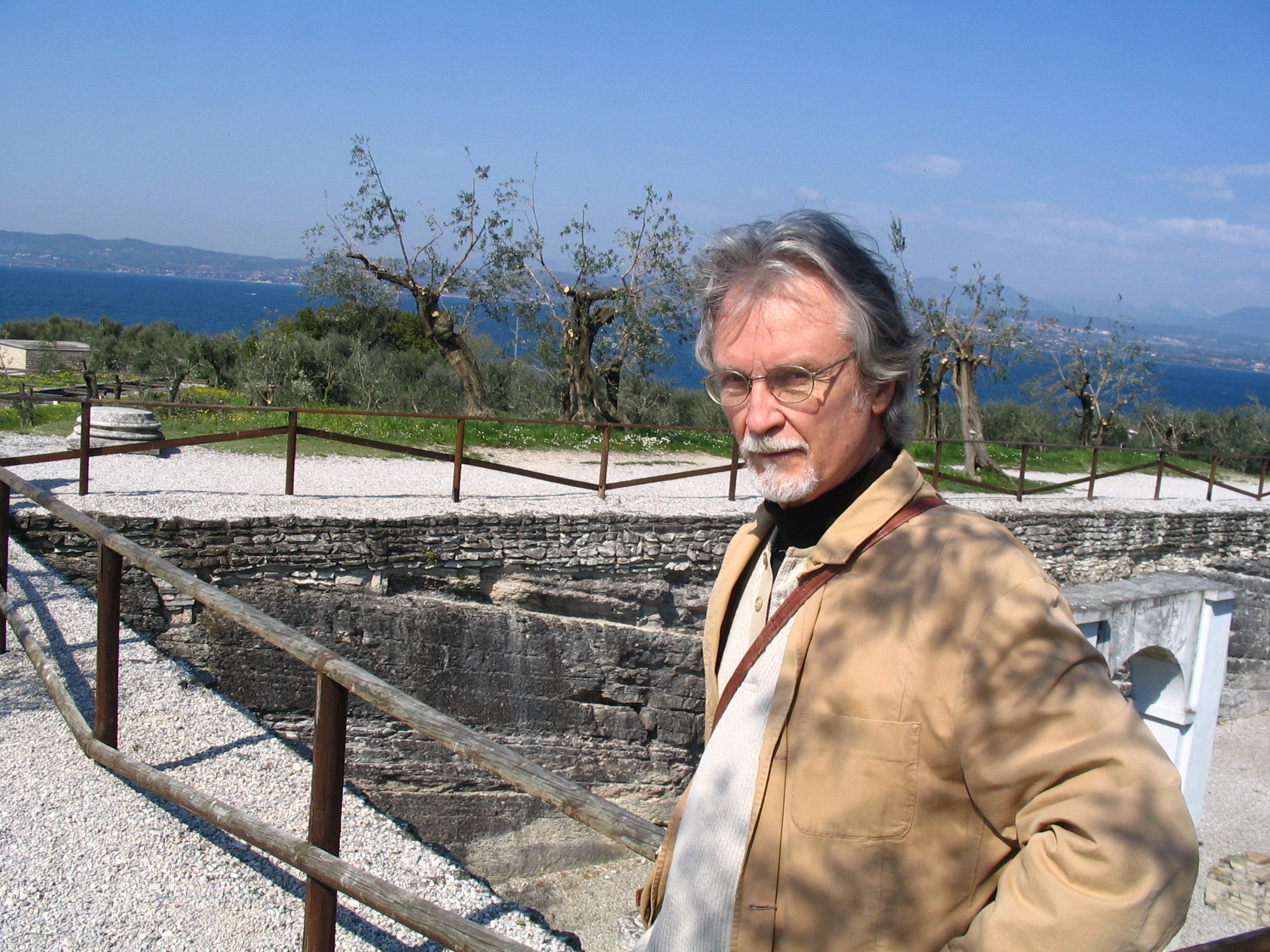
In 2014, Robert Hellenga, a novelist and professor at Knox College in Galesburg, Illinois, agreed to an inverview about his novel, The Confessions of Frances Godwin, a woman’s version of Saint Augustine’s Confessions. He was fascinating and one of the most generous writers I have interviewed.
An Interview with Robert Hellenga
Kat: The love of classical literature has shaped the identity of the narrator, Frances, a brilliant Latinist whose translation of Catullus has been accepted for publication. Why did you choose to make Frances a classicist, and is this an integral part of her character?
Robert Hellenga: I like to use the classical world as a frame of reference. It give us (me, Frances, the reader) a place to stand outside the modern world. Other things being equal I would have gravitated toward a college Greek professor rather than a high school Latin teacher, but I’ve already written a novel about a college Greek professor (The Fall of a Sparrow), so I didn’t want to do that again. I’ve studied Greek and Greek literature, but not much Latin or Latin literature, so I had to work up a “frame of reference” that resonated with me. So I reread Virgil and Catullus. The Aeneid gives us a sense that with the founding of Rome the world has turned a corner, that history has a sense of direction (as opposed to the Greek view that history just goes round in a circle). This is a view that Frances has to abandon at the end, when Father Viglietti tells her that what she needs is no absolution but a grappa and a nap. Catullus is already closer to this view. My wife and I have lived in Catullus’s home town (Verona) and last year we spent six weeks in Rome, so I had a sense of place to draw on in both cases.
Kat: I’m always interested in novels with Midwestern settings, because I’ve lived most of my life in the Midwest; yet there seem to be few Midwestern novels. Were you making making a radical decision by setting a novel in Galesburg, Illinois?
Robert Hellenga: The Midwest has been a theme in all my novels, generally in contrast to Italy. Our family spent a year in Florence in 1982-83 and it was a turning point in our lives. It’s hard for me to write a novel in which no one goes to Italy, although in Snakewoman of Little Egypt, the protagonist, Sunny, goes to France rather than Italy. Like the classical world, Italy offers a place to stand outside the Midwest, but in every case my Midwestern characters hold their own against their Italian counterparts. They love Italy, but the Midwest is home. In The Fall of a Sparrow, Woody is in love with a wonderful woman from Bologna. He wants her to move to Illinois; she wants him to stay in Italy. In a later novel, The Italian Lover, the same thing happens again, with a different wonderful woman.
The decision to set Confessions in Galesburg was a conscious decision but not a hard one. I didn’t need a big city (Chicago) for this novel; I didn’t need a big university, as I did in Snakewoman, which is set in a fictional town very near Galesburg. Galesburg has the last remaining site of a Lincoln-Douglas debate; it’s got Carl Sandburg’s old house. It’s got a great college, which I taught for many years. I didn’t need anything else.
Kat: Frances’s intense pain over the tragic decision of her daughter Stella, a poet in the Iowa Writers’ Workshop, to live with the dangerous ex-con, Jimmy, is intensely, disturbingly realistic. How were you able to portray the psychology of this fraught mother-daughter relationship?
Robert Hellenga: As I’ve often said, “A man with three daughters will never run out of stories.” My wife and I have never been seriously at odds with our daughters, but I think that all a father has to do it tap into his fear-fulfillment fantasies to come up with someone like Jimmy.
At an early stage of Confessions my agent said that he couldn’t understand what had happened to Stella to make her such a piece of work. “Abuse” would have provided a convenient explanation–the dark secret that eventually emerges–but that was out of the question for me. So I gave Stella a long history of making bad choices about men, a history going back to high-school bad boy Howard Banks, and later on the fact that she enters into a stable lesbian relationship with Ruthy suggests that maybe her sexual orientation was the problem all along, but I didn’t want to make too much of this. I just wanted it to be part of the frame, and Frances feels the same way.
Kat: Did any writers influence you in the writing of The Confessions of Frances Godwin?
Robert Hellenga: I keep going back to the same sources for inspiration: Tolstoy’s Anna Karenina, Jane Smiley’s Horse Heaven, and Gail Godwin’s Finishing School, Father Melancholy’s Daughter, and now, Flora. I didn’t exactly name Frances after Gail Godwin, but I sort of did. I started out with a name I liked, Frances Cochrane, but (a) I’d already used that name and (b) I didn’t want to suggest an Irish theme. I liked the way “Godwin” hints at a relationship with God (= “God-friend” in Old English).
Kat: What are you reading now and who are your favorite authors?
Robert Hellenga: Confessions was one of two novels assigned for a religious-studies course at Beloit College. The other was Joshua Ferris’s To Rise Again at a Decent Hour. I read a library copy and liked it so much I bought my own copy. Right now I’m rereading Kent Haruf’s Benediction and Richard Ford’s The Lay of the Land.
I’ll probably reread Elizabeth Strout’s Olive Kitteredge and Jane Smiley’s Horse Heaven, while I’m working on a new novel, and Anna Karenina too, though I’ve read it so often that I tend just to dip into in when I need a shot of writing adrenaline.
 “We’re fine,” I say on the landline. (I’m keeping it real.) Of course things are not fine. They are far from fine. At least we have enough books. Should we start a bookstore in our living room?
 And it is everything I need in a novel right now: it is a book about books! I am racing through this fictitious history of a family-owned antiquarian bookstore in Chicago, Chas. Johnson & Sons, from 1970 to 2011.