Tag Archives: tea

The Lucretius Club, or Why We Don’t Drink out of Teacups

So I’m 23 years old, and I’m trying not to drop my teacup, because the professor’s wife might come home, and how to explain our illicit tea-drinking club?  I was a nubile blonde back then, no, a nervous nubile blonde, he said fondly, and despite our difference in status, we enjoyed our Lucretius-translating tea parties.

For the first time, atoms were clicking around in my head. Lucretius adored atoms, and I began to understand physics.  Incredible, isn’t it?  what poetry and Epicurean philosophy can teach you.

The prof always offers milk and sugar.

“No, thanks,” I say.  I can balance a cup of tea on the saucer, but not the spoon.

He and I were sort of friends, sort of buddies, really.  We talked in the conference room about what novels we were reading until an irate professor ordered us to go to the lounge so he “could think.” My laid-back prof recommended  Rosellen Brown and Barbara Pym, while I urged him to try Ruth Prawer Jhabvala and Andre Dubus.  

Reading was our passion: that was our bond. While waiting at the reserve desk for the return of a scholarly journal on reserve at the library, I devoured the short stories of Raymond Carver and John Updike in The New Yorker. The library inevitably had only one copy of the journal with the assigned article, so I sometimes had to read the entire New Yorker.

But the Lucretius club was the highlight of the semester. Our bubbly casual chats about philosophy, broken up occasionally by literary analysis, bridged the gap between student and professor. In retrospect, he was a charming older man, though I took his charm entirely for granted. When you’re young, everyone is charming to you, because you see the world more kindly.

The memory of those rattling china tea cups remind me of Lucretius and his atoms.  I drink tea in mugs these days – they’re more stable, and hold more tea – but I might take out the old china in homage to this long-dead brilliant professor.

The Love of Tea:  Teabags or Loose?

Version 1.0.0

“Under certain circumstances there are few hours in life more agreeable than the hour dedicated to the ceremony known as afternoon tea. There are circumstances in which, whether you partake of the tea or not—some people of course never do,—the situation is in itself delightful.” – Henry James’ The Portrait of a Lady

I am an ardent tea drinker.  It started when I was 12.  Perhaps it’s because I read Henry James’ The Portrait of a Lady when I was a bit too young.

In those days it was difficult to find any tea at the grocery store except Lipton. I begged Mom to buy a box of Bigelow lemon tea when it mysteriously appeared on the shelf one day.  As I drank the lemon tea, I imagined drinking tea with Isabel Archer and Ralph Touchett in The Portrait of a Lady.

Bizarrely, on a trip to England, I drank coffee instead of tea. A disgrace to lovers of Henry James!

Jewel Tea Company Autumn tea set

My grandmother had a Jewel Tea Company Autumn tea set, which she bought with coupons. My mother helped her collect coupons. (Later, they both collected green stamps at the grocery store and bought any number of peculiar things, such as folding chairs and an encyclopedia.) I loved the orange autumn leaf design on Grandma’s teapot. I don’t know what happened to it. It may have been sold at auction because my relatives were unsentimental about “old” things.

 Years ago, I inherited my other grandmother’s tea set, decorated with garlands of pink flowers. Actually, I wonder if my aunt passed it on to me, because I remember her sending me a huge basket of tea. Grandma’s oldest son brought the tea set back from Europe after the war. What a thoughtful gesture. I never met him. He died before I was born.

These days  I seldom make “proper” tea. Teabags, as we all know, are easier to deal with. At grocery stores, health food stores, the co-op, and obviously tea shops, you can find every tea you can think of these days.  My favorites:  Earl Grey and Darjeeling. But I will drink almost ANY tea.

BELOW IS A LIST OF FAVORITE “TEA” BOOKS

Enderby by Anthony Burgess.  Enderby, a poet who likes to write in the bathroom, makes tea from the most ordinary teabags.  He doesn’t removes the teabag, because he likes it strong. Very strong!

My Turn to Make the Tea by Monica Dickens.  A comic novel about the adventures of Poppy, a young woman reporter for a small newspaper. There are many hilarious scenes, and naturally there is tea, and a grudging editor who thinks that women don’t belong in a newspaper office.


All of Barbara Pym’s novels.  Pym’s spinsters drink  tea, whether they are anthropologist, indexers, or office workers.  In Quartet in Autumn, four elderly people drink tea in the office and out. Then they retire.

Any book by Jane Austen.  There’s tea!  Everyone drinks tea.  Emma Woodhouse, Lizzie Bennet, the Dashwood sisters, Fanny Price, Anne Elliot, and Catherine Norland. Is that why I like Jane Austen?

Cranford, by Elizabeth Gaskell.  This charming novel focuses on women’s lives in the village of Cranford. They do drink lots of tea, and Miss Matty discreetly opens a tea shop after she loses all her money.

Swann’s Way by Marcel Proust. In the most famous scene, the narrator dips his Madeleines in his tea.

More tea, anybody? 

One Cup of Tea at a Time

I don’t have this mug, but isn’t it lovely?

“It’s common sense to make only one cup at a time,” a friend said.

I agree with her. “I see what you mean.”

Nonetheless, I have my ways. I am coming down with a cold, so I filled a teapot with Lapsang Souchong, a mug with vanilla chai, and a small cup with lavender tea. And then I got out a Victorian novel about the clergy drinking tea. They do drink a lot of tea.

But back to tea… First, Lapsang Souchong. It tastes smoky and sophisticated. I’ve always loved it, but why? It doesn’t exactly taste good. But when you’re feeling sick, it gives you that bit of courage you need to face the day.

Then there’s the vanilla chai. It’s very spicy. and I don’t know where the vanilla is, because it tastes like cinnamon! Good for the sinuses, though. You can certainly taste vanilla chai, despite the seeming absence of vanilla.

Lavender tea? So light, so gentle. It makes me feel like putting on a Regency gown and picking herbs in our herb garden. (The one I’ll have in the future.)

And now here are a few books with tea in the title or, at the very least, a lot of tea-drinking:

My Turn to Make the Tea, by Monica Dickens. (A comic memoir about working for a small newspaper)
Tea for Mr. Thorgill, by Storm Jameson (a novel in which much tea is drunk by elite, privileged Oxford students with the Master)
Death by Darjeeling, by Laura Childs (the first mystery in her tea shop series, with recipes in the back).
The Book of Tea (a book about tea)
A Cup of Tea, by Amy Ephron (an excellent novel by Nora Ephron’s sister)
The Guernsey Literary and Potato Peel Pie Society, by Mary Ann Shaffer (a popular novel_
Tea with Jane Austen (a book about tea occasions in Jane Austen’s England and Austen’s tea-making skills.)
The Portrait of a Lady, by Henry James (a classic about an American heiress, Isabel Archer, who makes a bad marital choice in Europe)
Quartet in Autumn, by Barbara Pym (a sad, funny novel about four co-workers who drink tea for years in the office and then meet various fates when they retire)

Well, it’s time for me to drink my so-called vanilla chai. What are your favorite teas and do you like tea books?

A Rerun from the Past: My Grandmother’s Tea Set & “I Capture the Castle”

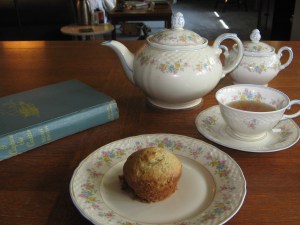
My grandmother’s tea set and my old copy of “I Capture the Castle.”

This is a rerun of a post from a VERY old blog (now defunct) I wrote in 2012.

September 24, 2012

I am having a very English experience today.

Yes, I am rereading Dodie Smith’s I Capture the Castle and drinking tea out of my grandmother’s tea set.  My idea of England is to drink tea and read mid-twentieth-century English novels.  Apparently my fantasy is not quite accurate.

In case you’re not sure whether tea is ever mentioned in Dodie Smith’s charming, humorous 1947 classic novel, I Capture the Castle, let me tell you it is.  In the first chapter, Cassandra is very excited when Topaz boils some eggs:  she hadn’t known the hens had laid any eggs, and had expected bread and margarine.  Cassandra writes in her diary:  “How odd it is to remember that ‘tea’ once meant afternoon tea to us–little cakes and thin bread-and-butter in the drawing-room.  Now it is as solid a meal as we can scrape together, as it has to last us until breakfast.  We have it after Thomas gets back from school.”

I reread I Capture the Castle every year and never am bored by it.  Usually I read it on Midsummer Night’s Eve, because there is a very funny scene in which Cassandra celebrates with a bonfire and some witchery. But this year I’m reading it two days after the Fall Equinox–do you think that counts?  Should I have a bonfire and witchery?

The narrator, Cassandra Mortmain, a 17-year-old aspiring writer, “captures” her life in a journal:  she and her family live in a mouldering castle, which her father, James, bought with the money from his  Joycean experimental novel.  But he has inexplicably stopped writing, sits in the gatehouse all day reading mysteries, and thus the Mortmains have no income.  In an amusing scene early in the book, the librarian, Miss Marcie, tries to help them figure out their earning power, and they are an unpromising lot:  Cassandra’s stepmother, Topaz, is a former artist’s model who loves to commune with nature in the nude; Cassandra’s beautiful 21-year-old sister, Rose, wants to marry but knows no men; and their younger brother Thomas is normal but still at school.  Only their servant, Stephen, has real earning power:  he can do manual labor.

Fortunately their interactions with  new American neighbors provide both free food and romance.  I am very happy to read Cassandra’s offbeat ruminations on her family, but I knew I needed tea and homemade muffins to make the experience perfect.

So what’s the story on the tea?

The Bavarian tea set in the photo was my grandmother’s.  Pink flower patterns aren’t really to my taste, but it was given to me because I am the only one in the family who drinks tea. I vaguely thought Grandma had bought it at Woolworth’s;  I got the Woolworth’s idea in my head because of all the stories she had told about being a farmer’s wife during the Depression and dressing my aunts in burlap feed bag dresses.

No, no, the tea set wasn’t that old!  It wasn’t a Depression tea set, my aunt said.  My uncle brought it home from Germany after the war.

Hmm, a guy’s taste:  no wonder the pink flowers.  Because we Frisbee women aren’t very flowery.  We’re practical.

Occasionally I it out and look at it, but we have broken a couple of the tea cups, so I usually leave it in the cupboard.   Today I enjoyed drinking lapsang souchang (not chosen to pair with the muffins, but because it is the only tea I had in the house) out of the delicate cup, though  I prefer drinking out of mugs, because they are durable. 

Now what’s with the muffins?  I know that’s what you really want to know.

I made them.  They’re banana muffins.  Does Cassandra eat banana muffins?  No.  I don’t believe bananas were on the menu.

But I bake what I have, and we had bananas.  These are not super coffeehouse muffins, just the kind of stuff your mom used to make.  If you use three bananas, they’re very moist, but I only had two, so, oh well.

They were good, though.

And you can get the recipe here at allrecipes.com