These books are still in progress, and are the kind of book to read when you’re almost too busy to read. The first is a novel about a couple in their sixties sheltering in place during the Covid pandemic in Manhattan. The second is a page-turning biography of Cicero. (I wonder if that phrase “page-turning biography of Cicero” has ever been used before!)
I am halfway through Jay McInerney’s See You in the Next Life, the fourth novel in a tetralogy about an upper-class Manhattan couple, Russell Calloway, the charming owner and editor of an independent publishing house, and his intelligent wife Corinne, the director of a large food charity.
Set during the Covid pandemic, the novel begins in the spring of 2020 when Italy was locked down but Covid cases were still rare in New York. No one knows much about the virus, and Russell and Corinne attend their friends’ thirty-fifth wedding anniversary party. Corinne is apprehensive about the crowd, but Russell is not concerned.
Soon the ramifications for the business world are clear: Russell must postpone the publication of books and cancel book tours or move them to Zoom. And Corinne’s food charity depends on donations from restaurants, so when the governor orders the restaurants to close, she must use emergency funds. And then she catches Covid. The anniversary party had been what would later be called “a super-spreader event.”
Really a sad book, not as light as it seems as first, but I recommend starting with the second or third book before reading this new one. The second in the series, The Good Life, is the best 9/11 novel I’ve read, and a good introduction to Russell and Corinne. I also recommend the third book, Bright, Precious Days. (I have yet to read the first, Brightness Falls.) You can read See You on the Other Side as a stand-alone, but I was glad I already knew the characters.
Josiah Osgood’s Lawless Republic: The Rise of Cicero and the Decline of Romeis a page-turning biography with an irresistible gossipy tone. For instance, Chapter 5, “Poison Is Detected,” is the story of Cicero’s fascinating murder investigation and court case. Cicero defended Cluentius, a wealthy man accused of poisoning three men, including his stepfather, who died, and his stepfather’s son, who survived.
Here’s an example of Osgood’s lively style and brillaint grasp of details: “For the Romans, poisoning was the most deceitful crime. It reminded them how vulnerable they were. The cup of wine your spouse handed you might have toxin mixed in. Or the medicines administered by your own doctor. … If a poisoner were sly enough. they would never be caught at all.”
This is an entertaining biography, even if you know nothing about Cicero, the famous Roman orator, gossipy letter writer, and down-to-earth philosopher.
And I hope you’ve all been reading entertaining books and enjoying the mild spring days.
This was pessimistic even for a pessimist; yet one of my poet friends described Dad as the loneliest man he knew. Near the end of his life, Dad couldn’t decide whether to apologize or spit in the faces of foes. (He and his second wife were quarreling, and he had an ongoing disagreement with a tenant.) Even if he were friendless, and with a sinking heart I realized that might be the case, I didn’t think he should declaim it publicly. In his 80s he was still active, working out at the gym and singing karaoke. As a child i remember his singing: “If I were a carpenter, and you were a lady…” ( I used these lyrics to teach the subjunctive in Latin class.)
Friendship, and even casual acquaintance, has been a great support in my life. Mind you, this isn’t the amicitia (“friendship”) valued by Cicero, a famous Roman orator, in his slightly priggish dialogue/essay, De Amicitia (On Friendship), written in the first century BCE..
Cicero uses the word amicitia more than 200 times in his writings, but the historical use of amicitia, used by Caesar, Livy, Sallust, Pliny, Tacitus, and others, describes a league or alliance of nations or politicians. Amicitia is a political alliance, or a buisness relationship, not necessarily a friendship.
In Cicero’s treatise, the main speaker, Laelius, explains that amicitia is lofty, honorable, and philosophical. You must mix only with the best people, because they are the only ones who understand friendship, and you must discuss only the loftiest subjects. In addition, you must be honest and critical to the point of cruelty. For reasons unclear to this common woman, it is necessary to speak the exact truth to your amici (friends) about their faults, with no shilly-shallying around.
After a chat with Laelius, one imagines his friends rushing out of the forum holding back tears. The Roman matrons would roll their eyes. That Laelius again! He should be locked up! But one thing I can say about Laelius; he speaks out firmly against slander.
Of course Cicero hated to see the fall of the republic and opposed the amicitia of the First Triumvirate, an alliance of Caesar, Pompey, and Crassus. And then there was the Second Triumvirate, the amicitia of Antony, Lepidus, and Octavian (who later became the emperor Augustus).
As for Cicero’s De Amicitia, it cannot be compared with other great ancient philosophical treatises. Cicero is remembered primarily as the greatest orator of his time, an elegant, witty writer and complex thinker. But his philosophy is simplistic. I respect his trying to write it: he had endless energy. But my reaction to De Amicitia is “meh” – because he can do so much better.
It is a hot, grueling day in late August. Five of us sit in a seminar room. One (that would be I) is armed with a cup of coffee from the Burger Dungeon; another has a cigarette; another brims with health after a wholesome breakfast; a stammering freshman has joined our ranks: and a spaced-out graduate student in English seems bored and negligent, presumably because he needs to study for his comps.
And then the professor strolls into the room.
Like all graduates of college prep schools, who go on to earn Ph.D’s. at Ivy League universities, he refers to us as “Miss” and “Mr.” (Never Ms. or Mrs.) He is a chain-smoker who lines up the cigarettes on the chalk ledge. We wait for him to mistake a cigarette for chalk. He explicates the political and personal background of Cicero’s racy speech, Pro Caelio, which we will read in Latin, marveling over convoluted grammar and figures of speech.
The professor likes to tease us. He says, weeks later, referring to me: “Miss ___ has a BBC accent.” Is it a compliment or an insult? (I think it was affection.) He also exchanges witty, affectionate repartee with the smoking student, who flippantly refers to particles as “throwaway words.” Like us stoic classics majors, Smoking Student just smiles.
Alas, this brilliant, even likable, professor is vicious to the weak. When the freshman translates peior avis as “worse bird,” rather than “worse than our ancestors,” he rips him to shreds. And truly, avis (nominative singular) can mean “bird”; just as avis, from avus, means “than our ancestors.” The Latin vocabulary is sparse, and the same words, and forms of words, have a dozen different meanings. It all has to do with context. I was sorry for the freshman, who did not belong in the seminar (yet).
In recent years, I have reread Pro Caelio with great pleasure: Cicero deflects attention from his client, Caelius, to Clodia, allegedly Caelius’s former girlfriend, and embarks on a sexist attack. He says that Clodia is an older woman, an adulteress who strolls around the pleasure gardens and preys on young men, and that Caelius has dropped her. Thus, she is getting revenge. Very little is known about Clodia: it is supposed that she was also the model for the poet Catullus’s girlfriend, who is known as Lesbia in his poems. But historians forget that there is a persona of the poems, that the “I” is not necessarily the poet, and that many such “loose” women are portrayed in Greek and Latin poetry.
Decades later, I appreciate Cicero’s sophistication and brilliant sentences even more. And yet I constantly worry about him. The republic is dead. He has powerful friends, and serves as consul and in other political positions, but he also collects many enemies along the way.
Even in his early oration, In C. Verrem, “Against Gaius Verres,” I am terrified for him. He is attacking the powerful Verres for corruption during his governorship of Sicily, where he extorted money and confiscated valuable art works from the Sicilians. He also killed many Sicilians.
Cicero goes to Sicily and investigates, and finds damning evidence, but there are delaying tactics in Rome to keep the case from going to trial, and a plot to keep Cicero from being elected aedile.
Fortunately, he does have friends: one of them comes to report on the politics behind the scenes. A powerful Roman official looks into the bribery, and sends some Sicilians home who should have testified in the case.
Cicero writes,
You may be sure that this incident did not please me. I understood very well what I must fear from it. Trustworthy friends and allies reported everything; that baskets were full of Sicilian money, and transferred by a certain senator to a Roman equestrian; and from these, as it were, baskets, ten were left for the senator, on account of my associates. The companies of all the voting tribes were called at night.
One of these men, who thought that he owed everything for my sake, came to me that same night. He explained the points of the speech: the corrupt politician had reminded them how liberally he had treated them before, when he sought the praetorship (office of governor), with many close friends among consuls and praetors. Then he went on to offer a huge bribe, whatever amount they wished, to keep Cicero from procuring the aedileship.
Cicero was known by all the famous people of his day. Catullus addresses a short poem to Cicero. I interpret it as a satire of Cicero’s style, though some think it is a heartfelt thank you (not Catullus’s style).
It is impossible to duplicate the effects of Catullus’s spare, elegant, comical Latin in our verbose English, and I don’t write poetry anyway. But calling himself “the worst of all poets” and Cicero “the best of all patrons” is hyperbolic and fulsome, very much in the style of Cicero’s letters.
This is essentially what Catullus says, but is NOT the poem.
Marcus Tullius, most fluent of Romulus’s descendants, as great as they are and were, so great will your descendants be: Catullus thanks you; Catullus, the worst of all poets, as much the worst of all poets as you are the best of all patrons.
And now I will end my homage to Cicero with a historian’s viewpoint. Anthony Everitt says in Cicero: The Life and Times of Rome’s Greatest Politician:
If few people read his speeches today for pleasure, his philosophical writings are masterpieces of popularization and were one of the most valuable means by which the heritage of classical thought was handed down to posterity. Cicero was not an original philosopher, but all his life he read philosophy and his writings are infused with a humane skepticism that reflects his character more than his age. In that sense, his greatest gift to European civilization was the man himself – rational, undogmatic, tolerant, law-abiding and urbane.
“You’re lucky if you have one friend.” – A Relative
Years ago, when my mother was in the hospital, one of her best friends visited. Like my mother, she was very old. Even though it was winter, she wore cropped pants and a short-sleeved shirt. Both women suffered a certain confusion that may well have been the result of the many, many meds that keep people alive.
It was somebody’s idea before a routine surgery that my mother should have extreme unction. And so a priest was called in to anoint her with oil, which she fastidiously wiped off with Kleenex as soon as he left the room. All three of us pretended it had never happened.
By the end of the visit, her lifetime friend was in tears. The friend told my mother, “You’re my best friend.”
My mother said nothing.
So the poor friend had to revoke it. “One of my best friends.”
I wish Mother had at least said, “Thank you,” but later she complained that her friend never came to visit, that nobody ever visited. I attribute this confusion to the illness, the morphine drip, and the strange surroundings.
And, like me, she was sometimes too honest.
Friendship is a complicated contract dependent on a web of love, fondness, respect, need, and enjoyment. According to Cicero’s treatise, De Amicitia (On Friendship), you should choose friends who have strong character and are virtuous, not mere networking buddies. Cicero praises friendship between noble, devoted men who see themselves when they see a real friend. (Not the way I’ve ever seen friends, but…) He admits it is difficult to form a friendship that lasts till death. People grow apart; their opinions change; they make other friends.
Cicero, the great orator, is not a very deep philosopher, but he is occasionally funny and does crack one joke. A Roman nobleman named Laelius, who is an expert on friendship, makes what passes for a wisecrack as he recalls that his friend Scipio “used to complain that men were more diligent in all other things than in friendship; that they were able to tell the number of goats and sheep a man had but not how many friends.”
Friendship is a complicated business in Balzac’s brilliant novel, Grand Illusions. When the hero, Lucien Chardon, moves from the provinces to Paris, he gives up poetry for the excitement of bad journalism. He reviews books he hasn’t read, accepts money for rave reviews of plays, and writes anonymous political articles on demand, adopting different views for different editors. But then he is asked to betray his friend, Daniel d’Arthez, by writing a vicious attack on his great novel. If he doesn’t, his editor threatens to ruin the career of Lucien’s mistress, an actress. And so Lucien goes to d’Arthez, sobbing, and shows him the article he has written. The wonderful d’Arthez offers to rewrite the article for him.
Later, d’Arthez writes a long, kind, but honest letter to Lucien’s sister, who has written a worried letter about gossip she has heard. Of the vitriolic attack on his book, d’Arthez says, “I made your brother’s crime easier for him by correcting the murderous article myself, and it had my full approval.”
He goes on,
“You ask me whether Lucien has kept my esteem and friendship. That question I find it more difficult to answer. Your brother is well on the way to ruining himself. At the present moment I am still very sorry, but before long I shall be glad to forget him, not because of what he has done, but what he is bound to do.. Your Lucien is very poetic, but he is not a poet…, Lucien would always sacrifice his best friend for the sake of being witty.”
And now on to something lighter! The friendships in Barbara Pym’s novel, No Fond Return of Love, are certainly familiar to women and provide light relief. Two indexers, Dulcie Mainwaring and Viola Dace, meet at an indexers’ conference. Both have gone to hear Professor Aylwin Forbes, their mutual crush. (Why else go to an indexers’ conference?) Though the two women are not exactly friends, Viola ends up moving in with her and they do form a bond. It is hilarious, one of her best.And, let me add here, we are all grateful for our true friends.
There are two kinds of classicists: the snobs and the proles. I am a snobbish prole, or do I mean a prole snob? For most of my life I have read widely in the canon of ancient literature. Though I do not make my living in classics, I occasionally enjoy a scholarly book such as Sarah Lindheim’s relatively light Mail and Female: Epistolary Narrative and Desire in Ovid’s Heroides.
Classics is not for everybody, yet I am grateful every day for an education by snobbish classics professors who taught not only Latin and Greek but the close reading of literature. Their obsession with grammar, style, figures of speech, and poetic meter blew my little undergraduate mind. And when I was offered a teaching assistantship at the only graduate school I applied to (the application fee of $25 was too expensive!), I was able to teach first-year Latin and Virgil as well as continue my studies.
Though sure of my language skills, I was apprehensive about teaching. My attitude was: You WILL do this, Kat! You HAVE to. And so I did. I was a gifted Latin teacher at the college level. My students enrolled for the language requirement but were hard-working and a pleasure to teach: they ranged from an extremely sweet frat boy (polite, never drunk) to a goofy English major who seemed dazed by the weight of the Complete Shakespeare to two brilliant pre-med students who were by far the best students. All eventually mastered grammar and read the Antiquae Sententiae in Wheelock, which is still a favorite first-year Latin textbook.
Teaching honed my Latin and my confidence. The only adverse effect of such an education on my personality was a certain snobbery, a disdain and pity for those who read the classics only in translation. I do have a strong feeling that classics professors, not English professors, should teach the Classical Lit in Translation classes. It baffles me that English professors can poach Classical Literature in Translation, when the same class is offered by the classics department–and taught by classicists! The particular English professor I’m thinking of dabbled in the Greeks but eschewed Roman literature altogether. O tempora! O mores!
Cicero
The real gift of my education, though, has been the solace of getting better-acquainted with the ancients through my own reading. This fall I had a literary fling with Cicero, and was extremely touched by his little-known speech, Pro Marcello (In Defense of Marcellus). Friends of M. Marcellus gathered in 46 B.C. in the Senate to ask Julius Caesar to allow Marcellus, who he had fought on the wrong side of the Civil War, to return from self-imposed exile. Cicero, who had also sided with Pompey, argued that Marcellus should be allowed to return safely to Rome as had Cicero and others of similar background.
This speech is as much a eulogy of Caesar as it is a defense of Marcellus. Cicero’s obsequiousness and flattery of Caesar can seem absurd, unless you are, like me, breathing a sigh of relief when Cicero manages not to alienate yet another powerful man and literally keep his head on. He needed to pay court to Caesar in order to help his friend. He tells Caesar that the pardon of Marcellus will be his greatest deed, that brilliant though his war prowess was, his deeds of peace and restoration of civilization would be even greater.
Here is a famous passage from the speech. Bear in mind all these words fit gracefully into two sentences in Latin.
Unless this city is stabilized by by your plans and institutions, your name will merely wander far and wide, and not have a stable place in history. There will be among those who will be born, just as there is among us, a great difference of opinion about your achievements: some will praise your deeds to the sky , others will think they lack some great signifiance, if you have not quenched the flame of civil war with the security of our country. The result of the deeds of war may seem to them the work of fate, but the stability of Rome will be praised as your own design.
Alas, Marcellus was assassinated while he traveled back to Rome. Dangerous times…
This has been a challenging spring. Veering off sidewalks for social distancing, searching for masks suddenly recommended by the CDC,and sacrificing civil liberties to stay home and stop the virus from spreading (as well as we can).
Terrified and saddened by the news, I have avoided reading even novels about the plague, with the exception of 150 pages of Connie Willis’s award-winning SF novel, Doomsday Book. In this absorbing book, the heroine time-travels to a Plague year in the 14th century.I may return to it later–much later.
Reading ancient literature is a distraction from the pandemic. I recently finished Cicero’s First Philippic against Marcus Antonius, one of fourteen speeches against Mark Antony.I adore Cicero, but may I just say, I am not quite sure which side I am on here.Antony is much sexier, at least in Shakespeare’s Antony and Cleopatra, which does make him more interesting, and though Cicero is brilliant, and often endearing in his letters, he has no sex appeal, which shouldn’t matter at all. I do imagine he would be the kind of person you’d love to gossip with at parties.
And it doesn’t help that Cicero spends the first four pages of the speech making excuses for his absence from the senate from June to January. (He had fled Rome.). But hetakes advantage of Antony’s rare absence from the senate to imply that Antony is not ill at all. And, damn, he is effective!
Here’s the thing. The Fourteenth Philippic, which I read less summer, is much more exciting. The First is far from his best work.
I was also distracted by faded penciled marginalia in this 1952 reprint of a 1926 Latin edition. I spent a lot of time deciphering this student’s notes.
Most of his/her notes are elementary, but the handwriting is so beautiful I kept thinking it mght be useful. Well, no, but:“Father-in-law” she scrawls, with a line pointing to the Latin word socero.She circles last and first syllables ofwords that belong together. Above a perfect infinitive (influxisse) in the middle of a line, she wrote what looks like “Laura.” I decided she meant “dawned,” but it still looks like Laura
I don’t usually buy books with marginalia, but this one turned up at a sale, and I do think the introduction and commentary are brilliant. In the preface, the editor J. D. Denniston expresses ambivalence about Cicero.
Some readers will think I have done less than justice to Cicero, as a man and as a statesman.I admit that he was in many respects an attractive person, a pure liver in a licentious age, and an unusually honest provincial governor…He has been unfortunate, not doubt, in bequeathing to posterity a correspondence which has furnished so much of the evidence against him.
I love Cicero, the most brilliant writer of his time, but he can be exasperating.
“Cicero Denouncing Catiline,” The Comic History of Rome.
Have you ever met one of your favorite writers?Was he/she glazed after lecturing to 100 people and giving autographs to the whole audience? Did he/she get your name wrong?You will hilariously show everyone the signed title page, “Best wishes to Carrie (from illegible).”(Your name is Mary, or perhaps Kelly.)
That writer may not have been at the peak of his/her charm at the event. And the less you expect, the better.Some writers are amiable and make an effort (you have bought their book, after all), others are too busy craning their neck at the editor in the back of the room.
One guesses that Cicero was too busy networking to chat with fans.This, however, would not have bothered Dickens’s Mrs. Blimber, an eccentric character in Dickens’s Dombey and Son. She would make the best of any encounter—because she says she wishes she could have met Cicero.
Mrs. Blimber has not read Cicero, but she is married to one of Dickens’s most rigid classical headmaster/teachers, Doctor Blimber.
Mrs. Blimber…was not learned herself, but she pretended to be, and that did quite as well.She said at evening parties, that if she could have known Cicero, she thought she could have died contented. It was the steady joy of her life to see the Doctor’s young gentlemen go out walking, in the largest possible shirt-collars, and the stiffest possilbe cravats.It was so classical, she said.
She is eloquent about the classics after Mr. Dombey enrolls his six-year-old son Paul at the school. She gushes that she envies Paul.
“Like a bee, Sir,” said Mrs. Blimber, with uplifted eyes, “about to plunge into a garden of the choicest flowers, and sip the sweets for the first time.Virgil, Horace, Ovid, Terence, Plautus, Cicero.What a world of honey have we here.”
Back to writers: have you met a favorite writer?Was it inspiring, or a let-down?
Tell all, please! I used to go to a lot of readings. Nowadays I stay home and read the book.
NOTE: I may or may not have a signed copy of Ken Kesey’s One Flew over the Cuckoo’s Nest. First I asked his brother, who looked just like him. Then Ken Kesey himself (I think) doodled a flower on the title page. I treasure this book. Signed or not, it’s a good story.
Every autumn I sit under multiple blankets, drinking cups of chai, surrounded by dictionaries, poring over my favorite literature in a foreign language. I swear the comfort of dictionaries—a word can change its meaning entirely when combined in different phrases, in different contexts—makes it possible to escape from the gloom of chilly fall days.Recently, reading in another language distracted me from my fierce fights with 25-mile-per-hour winds on my bike, and a wish that our leaves would blow into somebody else’s yard.
Thank God for the charm of languages! Hipsters read French, Italian, Japanese, and Spanish, travel, and perhaps join the Peace Corps, while nerds read classical languages and often stay home. Much as I love Latin, you will not get social points for spending the summer reading Statius.And claiming you dream in Latin is, in my opinion, always going too far. That is not to say that I have not gone far: and yet, one does not want to be a don or a scholar (unless you’re Mary Beard). A language is more than words: it shapes the culture and the structure of thought.It is difficult to translate this reality to people who do not know a foreign language. And in the U.S., where we seldom bother to learn other languages, xenophobia grows.
I hide the fact at dinner parties that my“affair” withCicero, a binge-reading of his speeches and letters, turned into a sympathetic imaginary dialogue with this brilliant, annoying, insecure orator.In a flash,I understood his character and the politics of the first century B.C. as I had never experienced through reading history.I flashed on the elaborate networking, the insane politics, the chances Cicero took with prosecuting mobsters:he wanted political fame so desperately that he wrote letters beggingfriends to write the history of his suppression of Catiline’s conspiracy against Rome.
I see Latin poetry through scrims of different readings and interpretation over the decades.Is Ovid’s myth of Daphne and Apollo in Metamorphoses humorous or tragic? Is it about unrequited love or rape? Probably both. Cupid shoots the god Apollo with an arrow of love and shoots the nymph Daphne with an arrow of repulsion.Daphne runs away, and the out-of-shape Apollo chases her, begging her to run more slowly, promising he will run more slowly, too.She is dedicated to the chaste goddess Diana, and begs her father, Peneus, the river god, tosave her.He turns her into a laurel tree, which Apollo obnoxiously claims as his own.
As an undergraduate I scribbled the following irreverent remarks in the margins:
Couldn’t Peneus have done better? Why a tree?
Is she a lesbian?Is that the arrow of repulsion?
Why does Prof think this erotic?The wreath holds her rumpled hair “without law.” She is a mess and prob stinks from running.Unshaven legs, I’m sure. A modern feminist. (N.B. We didn’t often shave our body hair back the.)
I could have garbled on like this forever, but I doubt it went into my paper on Ovid.
Fresco of young man holding a scroll, 1st century A.D., Herculaneum
I am taking a break from the eloquence of Cicero to read Pliny’s relatively undramatic letters. Cicero’s court cases are almost too exciting. I am impressed and yet terrified by his bold prosecution of Verres, a gangster-governor of Sicily who stole both public and private art and bribed the jury of the court in Rome. I’d never had the slightest interest in Verres before.
Yet there’s something to be said for simplicity. Pliny (61 A.D.- 113 A.D.) favors a plain, minimalist style. This wealthy Roman lawyer and successful politician was best-known as a writer of polished letters composed for publication.
Among Pliny’s most famous letters are a brilliant account of the eruption of Vesuvius in 79 A.D.;a trio of ghost stories ; a charming story of a boy who swam with a dolphin; and a letter asking the emperor Trajan for advice on how to deal with Christians while Pliny was governor in Bithynia.
But I’ve especially enjoyed a witty poem by Martial quoted in a letter written on the occasion of the poet’s death. Pliny writes that he has a whole volume of poems Martial wrote for him. (He was one of Martial’s patrons.)
Below is my prose translation of Martial’s playful Latin poem. Here, he advises the Muse not to knock on Pliny’s “clever” or “eloquent door” while drunk (literally in an “inebriated time”). I would love to preservethe fun of Martial’s“transferred epithets,” i.e., adjectives transferred from persons to inanimate objects, but it doesn’t quite work in English. Instead of changing the “eloquent door”to “eloquent Pliny,” I prefer a magical talking door. When you’re drunk, mightn’t you hear a talking door? But it is too wordy in English.
Here is Martial’s advice to the Muse.
Don’t knock while sloshed at Pliny’s door.He devotes whole days to harsh Minerva, while he prepares a case for the ears of 100 men (the centumviral court where wills and property cases are heard). Posterity and the ages will compare this to the writings of Cicero. But it’s better to visit when the evening lanterns are lit:this is your hour, when Bacchus (god of wine) maddens, when the rose rules, when the hair drips with unguents.Then let even the severe Catos* read me.
Ancient Rome was violent and decadent.If you’ve binge-watched the TV series Rome or perused Mary Beard’s best-selling history SPQR, you know that Rome seethed with wars, civil wars, conspiracies, gang warfare, assassinations, exile, poisonings, insanity, promiscuity, lead poisoning, and capricious emperors.
War veterans in ancient Rome obviously suffered PTSD (post-traumatic stress disorder), but the psychological cost of exile is also treated in Roman history and literature.In Virgil’s Aeneid, the traumatized hero-warrior Aeneas survives the fall of Troy but then must reluctantly lead the survivors into exile—because the gods force him to.
And Ovid, the frivolous, brilliant poet, was capriciously exiled by the emperor Augustus in 8 A.D. for carmen et error (a poem and an error).In letters written in the form of poetry, Tristia (Sad Things) and Epistulae ex Ponto (Letters from the Black Sea), the urbane Ovid begs his friends to intercede on his behalf, because he does not thrive among barbarians in Tomis on the cold shores of the Black Sea. But he died in exile in 17 A.D.
And then there’s Cicero, the most eloquent lawyer and orator in Rome, who was elected consul (the highest office) in 63 B.C. He boasted of his achievements, especially of having crushed the revolutionary conspiracies of Catiline.But in 58 B.C., he went into exile in Greece, mainly because of the political machinations of his enemy Clodius (which also benefited Julius Caesar).
Cicero’s letters home are pathetic.He wonders:has the government stripped his wife Terentia of their land and property?Are the children all right?
O desperate me! O ruined me! What now?Should I ask you to come here,a sick woman, exhausted in body and mind?Should I not ask?Should I be without you?I think I should deal with it thus:if there is hope of my return, let me know and help manage the affair; but if, as I fear, it has not been settled, come to me any way you can.And know this:if I have you, I will not seem entirely lost.But what will become of Tulliola [their married daughter]? You must see to it:I have no counsel for you.But however the matter turns out, my unhappy little one’s reputation and marriage must be saved.What else? What should my son Cicero [age 6] do?May he always be in my embrace and protection.I cannot write more now.My sorrow prevents it.
Near the end of the letter, he courageously writes,
We have lived; we have flourished.Not our vice but our virtue has ruined us.There is no sin, unless it is that I did not lose my life along with honors.
Cicero returned from exile to his beloved, deadly dangerous Rome in 57 B.C. He continued to write and deal with other powerful men until he was put to death in 43 B.C.


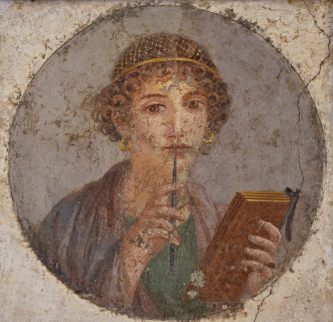


 Reading ancient literature is a distraction from the pandemic. I recently finished Cicero’s First Philippic against Marcus Antonius, one of fourteen speeches against Mark Antony.
 Every autumn I sit under multiple blankets, drinking cups of chai, surrounded by dictionaries, poring over my favorite literature in a foreign language. I swear the comfort of dictionaries—a word can change its meaning entirely when combined in different phrases, in different contexts—makes it possible to escape from the gloom of chilly fall days.
