
I am an inveterate rereader. Some favorite books enchant me on multiple readings; others are not fully appreciated on a single reading. I may be eccentric, but I prefer rereading to keeping up with the critically-acclaimed new books.
And by new, I mean hot off the press. After a certain age, one is maddeningly familiar with the trends and tropes. One sees the skeleton awkwardly poking through the prose. I am picky, almost too picky. I approach the latest books in a hazmat suit, like a member of a bomb squad.
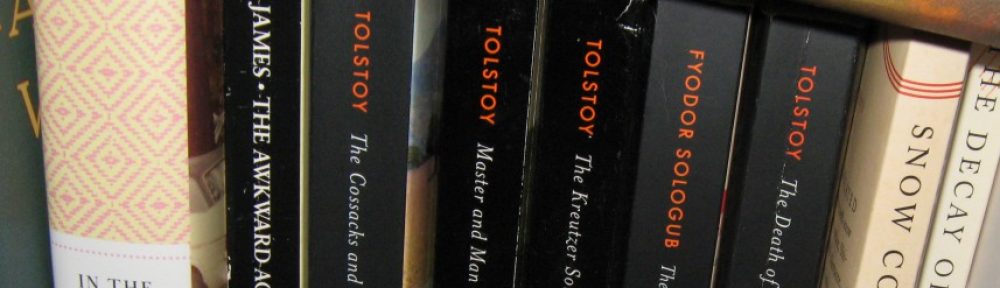
Rereading is an intense experience, like revisiting a beautiful landscape and seeing it from a different perspective. On my first reading of Anna Karenina, I barely noticed Dolly, a minor character who lacks the glamour of her vivacious sister-in-law, Anna, or the charm of her younger sister, Kitty, who is excited about attending a ball.

In the opening chapters, the faded Dolly, mother of five children, is devastated because her husband has been cheating on her with the governess. The house is topsy-turvy, the cook has left, there is no milk, and she plans to move back to her parents’ house. She shrieks at Oblonsky, “You are loathsome to me, you are repulsive!” (Yes, Dolly, he’s a toad!)
And so he sends a telegram to Anna, his sister, and she comes for a visit and persuades Dolly to forgive him. Anna says that he really loves Dolly, and that the other woman is nothing to him. And so Dolly forgives him and then fades into the background.
Tolstoy is interested in her as a type, as a contrast to Anna. And yet his portrayal of Dolly is brilliant and believable: his genius animates her. Dolly’s experience is common: the note found in the pocket may be a cliche, but there is always a clue. Statistics on the percentage of adulterers who are careless with their notes, emails, phones, etc. are probably studied by sociologists. Having read Anna Karenina multiple times, I am now moved by Dolly’s desperation, because the thirties are just a vale of tears, as I remember, for all kinds of reasons. It’s the human condition. I identified with Anna and Levin, because these two opposites were my favorite characters.
Sometimes I return to a book I suspect I have not fully appreciated, like Elaine Dundy’s The Dud Avocado, published by Virago and NYRB Classics. On a second reading, this enchanting little novel made me laugh out loud. Sally Jay Gorce, a young American in Paris in the 1950s, is an aspiring actress who wears evening dresses during the day. She tries to be blase when she runs into her old friend Larry, with hilarious results: “I saw a stinking art film the other night” and “I don’t like possessions. I travel light so I can make my getaway.” At a “queer club,” which flabbergasts her, with its dozens of flirtatious sailors, flirting more outrageously than any woman, Larry explains,“Faggotry has reached almost pyrotechnic proportions.”

This is basically a romance: Sally Jay falls in love with Larry. He seems to consider her a younger sister. But how can he resist Sally Jay? She is so funny, like a smarter Holly Golightly. I’d love to go back in time and be Sally Jay myself.
But I did find the book meandering the first time around and asked myself, “Why am I reading this?”
Now The Dud Avocado is one of my favorite books.
And now I’m off to do some rereading, inspired by myself.


